Fear of Driving in Practice: VR Exposure Environments for Professionals
By Equipo clínico VRET
Fear of driving is a frequent reason for consultation in private practice, and it often arrives late. In vivo exposure raises serious logistical problems: a second driver, insurance, legal liability and gradation. A virtual reality environment lets the psychologist work with traffic, highways, rain and night driving at adjustable intensity, with no road risk and no dependence on a family member. This article reviews how the problem presents in practice, what the literature has examined and an indicative structure that the professional adapts to each case.

An Underestimated Reason for Consultation
Fear of driving (amaxophobia, in clinical terminology) shows up in private practice more often than is usually assumed. Some epidemiological samples place it at around 5-10 percent of adult drivers, with a slightly higher proportion of women and a mean age of onset between 25 and 45. The problem typically consolidates after a minor accident, a panic experience behind the wheel, or a prolonged period without driving.
The functional impact is significant: loss of autonomy, dependence on others, giving up job opportunities that require mobility, strain on family dynamics, and, not infrequently, permanent abandonment of driving altogether. In rural or peri-urban settings, this loss translates into isolation.
Yet fear of driving tends to reach the consulting room late. Many people accumulate years of avoidance before seeking help, have tried conventional driving schools without success, or have only received symptomatic medication. By the time they finally consult a psychologist, the avoidance network is well established and perceived self-efficacy behind the wheel is close to zero.
Why In Vivo Exposure Is Logistically Complex
The reference approach in the literature on specific fears, progressive in vivo exposure, runs into practical obstacles when the feared situation is driving. First, insurance coverage: the psychologist is not typically listed as an authorized additional driver, and civil liability for an incident during a session would be hard to defend.
Second, the availability of a second driver or co-therapist. Even when the patient drives with a family member, the relational dynamic contaminates the exposure: the family member tends to either overprotect or pressure, and rarely holds to the graduated hierarchy that inhibitory learning requires.
Third, real gradation. An in vivo session cannot reproduce rush-hour traffic, a highway merge in the rain, or a left turn at a five-lane intersection on demand. The professional is at the mercy of actual traffic and weather, which stretches the work out over months and undermines adherence.
What a VR Environment Adds to Exposure Work
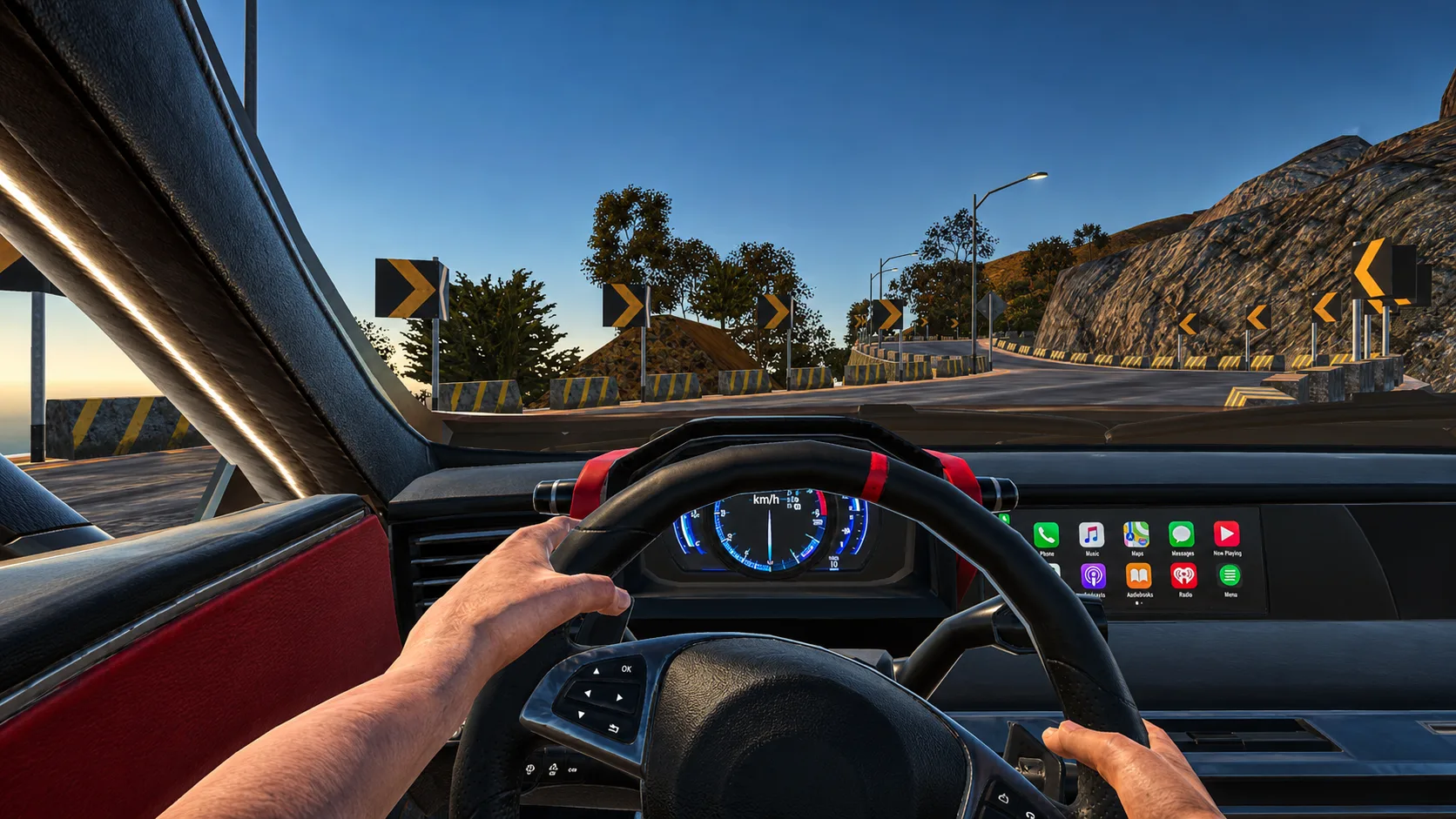
A virtual reality environment removes many of these logistical obstacles. The psychologist has, right in the office, a reproducible and adjustable driving environment. In the VRET Road driving scenario the professional can adjust the road type (straight, curves, mountain ledge road, dual carriageway, motorway), speed, traffic density, weather, time of day and cabin motion intensity, and trigger discrete events such as an overtaking truck, an abrupt merge or sudden braking ahead.
The session takes place seated in the office, with no real road risk, which allows the professional to plan exposure with people whose avoidance is very severe, including those who will not even sit in a parked car.
Recording subjective SUDS ratings and, if the professional uses it, the physiological signal helps the psychologist decide how to plan the next session. The psychologist can repeat the same segment as many times as they see fit, introduce controlled variations to avoid context dependency, and organise the exposure work without depending on real traffic or weather.
What the Literature Says
Virtual reality has been used in psychology for more than 25 years, although the specific literature on fear of driving is smaller than for flying or heights. Wald and Taylor published an initial small-sample study in 2003 that examined virtual reality exposure in this context, and Walshe and colleagues described the same year a protocol combining virtual reality and in vivo exposure in people with a prior accident.
Beyond the specific studies, the broader meta-analyses by Carl and colleagues (2019) and Powers and Emmelkamp (2008) compared virtual reality exposure with in vivo exposure for specific fears. The authors themselves point out the limits of extrapolating those data, and in the literature exposure in a virtual environment is usually paired with in vivo transfer exposure.
These studies should be read with caution: the heterogeneity of stimuli (urban, highway, rain) and the limited standardization of protocols mean that situation-specific meta-analyses are still scarce. The decision to use a virtual environment, and at what point in the intervention, always rests with the professional, especially when in vivo exposure is not feasible.
Initial Assessment and the Professional's Criteria
The initial assessment carried out by the psychologist includes a structured clinical interview, specific scales such as the Driving Cognitions Questionnaire (DCQ) or the Anxiety When Driving Scale, a detailed record of the avoidance network (routes, times, avoided roads), the history of the accident or triggering event, and a review of comorbidities.
Exclusion criteria commonly described include unstabilized active PTSD related to a serious accident, dissociative conditions, acute-phase psychotic conditions, refractory cybersickness sensitivity, active substance dependence, and severe visual or vestibular conditions.
It is also worth checking the legal status of the patient's license. If the patient hasn't driven in several years, they may need refresher lessons at a driving school after the virtual reality exposure phase; anticipating this step when planning the intervention helps avoid frustration after months of exposure work.
One screening step is worth building in every time: ask whether there was a crash and what happened afterwards. Fear of driving of traumatic origin and post-traumatic stress with driving avoidance share the visible behaviour but lead to different intervention plans.
Three questions discriminate well. Whether images of the crash appear when the patient is not driving and not thinking about it; how they have slept since; and whether they have stopped doing anything besides driving. Spontaneous intrusion, generalised hyperarousal and avoidance extending beyond the wheel do not fit a pure specific fear, and in those cases a driving hierarchy applied on its own usually stalls in the early levels.
Where there is an index event, the hierarchy is reordered around its specific configuration rather than around speed. If the collision was a rear-end shunt in stationary traffic, the hard level is the queue with vehicles very close by, not the motorway at cruising speed. Capturing the exact topography of the crash prevents building a hierarchy the patient clears without ever touching the critical stimulus.
It is also worth exploring partial avoidance, which is the norm here and goes unnoticed because the patient is still driving: longer alternative routes, low-traffic time slots, an indispensable front-seat passenger, following distances far above the norm, or compulsive rear-view mirror checking. The question that identifies them is what the patient thinks would happen if they did not do it; if the answer is a specific catastrophic prediction, it is a safety behaviour rather than caution.
Stimulus Hierarchy and Exposure Design
A hierarchy commonly described in the literature moves through ascending levels. First, sitting in the driver's seat of a parked vehicle, getting familiar with the cabin and controls. Second, driving in an empty parking lot. Third, low-speed, low-density urban residential streets. Fourth, urban roads with traffic lights, pedestrians, and left turns.
Fifth, secondary roads with curves, blind crests, and unsignaled intersections. Sixth, merging onto an expressway. Seventh, highway driving with heavy traffic. Eighth, night driving and adverse weather. Ninth, complex intersections and multi-lane roundabouts. Tenth, a controlled unexpected event: sudden braking ahead, a vehicle merging without signaling. In the VRET Road driving scenario the person travels in the vehicle's cabin while the professional sets road type, traffic, weather, time of day and events from the panel; steps that require handling the controls belong to in vivo practice.
The professional decides when to move up a level, usually when they observe within-session habituation and SUDS below the agreed threshold in consecutive sessions. Avoiding premature escalation is one of the most repeated recommendations in the literature on driving exposure.
Indicative Structure of the Intervention
The literature describes protocols of 8 to 12 sessions, although the duration is decided by the professional for each case. A common sequence includes one assessment and feedback session, one psychoeducation and hierarchy-building session, several sessions of progressive exposure, one consolidation session with unexpected events, and one final session for the real-vehicle transfer plan with relapse prevention.
Each session usually runs around 50-60 minutes and the most common frequency is weekly; some professionals choose a more intensive format at the start when the person tolerates it well. Closing each session includes recording peak SUDS, predominant cognitions, and a between-session task plan (gradually approaching the real car, sitting in the seat, starting the engine in the garage).
Closing out the intervention involves coordinating with a suitable companion, ideally a professional instructor, to carry out in vivo transfer exposure: familiar routes, secondary roads, and finally expressways and highways. A well-planned transfer helps carry what was worked on in the virtual environment over to real-world driving.
Common Cognitions and Parallel Cognitive Work
People who fear driving tend to present a recognizable cognitive repertoire. The most frequent cognitions are: 'I'm going to lose control of the car,' 'I'm going to have a panic attack and won't be able to stop,' 'I'm going to crash into another vehicle and hurt someone,' 'my attention isn't good enough to drive,' 'I'm going to get dizzy and pass out at the wheel,' and 'I'm a danger to others if I drive.'
Each of these cognitions deserves specific cognitive work: identification, recording the situations that trigger it, examining the evidence for and against it, and building a more balanced alternative. Exposure in the virtual environment provides concrete material for this work: the person can compare their prediction ('I won't be able to stand the car on the motorway') against what they observe ('I stayed in the car for the whole segment').
Cognitive work running parallel to exposure isn't secondary: many authors consider it a central component for maintenance over the medium term. It's worth setting aside explicit time in each session to review predictions and consolidate the competing belief.
The Role of Optional Biofeedback
Some professionals add electrodermal activity recording during exposure. The VRET sensor shows that signal in real time; the professional interprets it and decides, for example, whether to keep or change the intensity of the environment. It can also help them notice physiological changes that the person does not perceive.
Biofeedback is best presented as complementary information, not as the sole criterion. Discrepancy between the physiological signal and subjective SUDS is common at the start, and it is the professional who weighs it.
In the Road driving scenario, VRET puts the traffic, road, weather, time-of-day and event controls in the panel; the professional chooses, adjusts and controls the environment at all times. If you want to assess whether this scenario fits your practice, you can book a demo with the team.
This article is for informational purposes for psychology professionals and is not clinical advice for any individual case. VRET is a support tool for professionals. It is not a medical device, does not diagnose or treat any disease and does not replace the judgement of the professional, who is responsible for its use.
Frequently asked questions
How long does a full intervention with VR driving exposure take?
There is no fixed duration: the professional decides according to each person's situation. The literature describes protocols of 8 to 12 weekly sessions of 50-60 minutes, plus a final transfer phase with a professional companion in a real vehicle.
Can a patient give up driving if resuming it isn't necessary?
That's a personal decision the psychologist should respect. It's worth assessing whether it reflects a genuine preference or a rationalization of avoidance; in the latter case, avoidance tends to spread to other contexts.
Can people with a prior serious accident work with VR?
That is the professional's decision. The case often fits a post-traumatic stress approach better than a specific-fear one; it is worth stabilizing post-traumatic symptoms first, ruling out severe dissociation and adjusting the gradation to avoid reactivating intrusive memories.
Can the VR headset be used with people over 65?
Age alone does not rule it out, but the professional should assess vestibular sensitivity, possible eye conditions, and familiarity with technology. A first contact with a static environment is advisable before introducing driving in motion.
How should a private practice price a VR exposure session?
Common practice is to bill the VR session at the same rate as a standard clinical session, or with a modest add-on for equipment use — see our current plans for reference. Being upfront from the start about the expected duration avoids financial misunderstandings.
Can it be combined with medication?
Exposure can coexist with stable antidepressant medication prescribed by a physician, but many authors advise against as-needed benzodiazepine use immediately before exposure, given its possible interference with inhibitory learning.
Is fear of driving after a crash approached the same way as fear with no index event?
Not entirely. First separate the specific fear from post-traumatic stress with driving avoidance: if there are intrusions outside the situation, sleep disturbance and avoidance extending beyond the wheel, the traumatic component should be addressed first or in parallel. And where there is an index event, the hierarchy is reordered around the configuration of the crash rather than around speed: after a rear-end shunt in stationary traffic, the hard level is the queue, not the motorway.
Keep reading
Fear of Driving After a Crash: Situational Fear or Post-Traumatic Presentation?
Fear of driving after a crash: the criteria professionals use to tell a situational fear from a post-traumatic presentation, what to address first, and how to build the driving hierarchy.
Situations and environmentsEnclosed-Space Exposure Hierarchy: Nine Graded Levels for Professionals
A nine-level hierarchy for working with fear of enclosed spaces, built on two independent axes, the differential with agoraphobia, and a brief format for people referred ahead of an MRI scan.
Situations and environmentsFear of Heights vs Vertigo: A Practical Differential for Psychologists
Fear of heights, vestibular vertigo and visual height intolerance get confused in practice. Five intake questions, two questionnaires and clear referral criteria for professionals.
VRET is a support tool for professionals. It is not a medical device, does not diagnose or treat any disease and does not replace the judgement of the professional, who is responsible for its use.