Working With Fear of Flying in Practice: A VR Exposure Sequence for Professionals
By Equipo clínico VRET
Fear of flying is common among adults, and in-vivo exposure is logistically unworkable for most practices. Virtual reality can reproduce key stimuli of air travel (takeoff, cruise, turbulence, landing) and let the professional present them in a graded, controlled way. Virtual reality has been used in psychology for more than 25 years; published studies, from Rothbaum and colleagues (2000) to the meta-analysis by Carl and colleagues (2019), have compared VR exposure with in-vivo exposure and reported comparable results. This article describes how a licensed psychologist might structure the sessions in practice.

Why Fear of Flying Suits VR Exposure Work
Fear of flying, classified in the DSM-5-TR as a situational-type specific phobia, has an estimated prevalence of roughly a quarter of the adult population when subclinical presentations are included, with 2 to 6 percent meeting full diagnostic criteria. The functional impact is significant: lost job opportunities that require travel, family isolation, abandoned life plans, and frequent misuse of self-prescribed anxiolytics.
The usual clinical challenge is the practical impossibility of exposing the patient to a real aircraft with the frequency and gradualness that a behavioral protocol requires. Imaginal exposure, even when well conducted, depends on the patient's capacity for visualization and their tolerance for the dissonance between the mental representation and the physiological response. Virtual reality helps bridge precisely that sensory gap.
From an operational standpoint, a VR headset can reproduce the cabin and the dynamics of flight with enough fidelity to elicit the fear response without requiring any travel. The psychologist controls the stimulus intensity at every moment and can adjust variables such as the flight phase, turbulence, weather or the window shade.
Neurobiology of Anticipatory Panic
The phobic response to flight-related stimuli results from a threat-processing circuit in which the amygdala labels the signal as dangerous before the medial prefrontal cortex can even intervene. In aviophobia, this bias is typically consolidated through associative learning, generalization, or vicarious transmission.
The hippocampus contextualizes the stimuli: a narrow seat, a particular smell, a slight vibration can recall previous episodes. The ventromedial prefrontal cortex, responsible for top-down regulation, tends to be inhibited during phobic activation, which explains the sense of lost control patients describe.
Repeated exposure without aversive consequences favors habituation and, above all, the inhibitory learning proposed by Craske and colleagues: the original learning is not erased, but a competing memory is built that activates earlier in the presence of the stimulus. VR facilitates this process because it allows multiple trials across varied contexts within a single session, something impossible on a real flight.
What Published Studies Report
The randomized controlled trial by Rothbaum and colleagues, published in 2000, was among the first to compare VR exposure with a waitlist control in fear of flying, reporting differences in favor of VR exposure over the waitlist that were maintained at six months. Da Costa, Sardinha, and Nardi later reported similar findings in a Brazilian sample using a shorter protocol.
The meta-analysis by Powers and Emmelkamp (2008) and the 2019 update by Carl and colleagues reported that VR exposure performed comparably to in-vivo exposure in studies of specific phobias. Some fear-of-flying studies have reported higher protocol completion rates than those described for in-vivo exposure, which the authors relate to adherence.
These findings deserve some caveats: most studies have limited sample sizes, and protocols vary in number of sessions and in the degree of subsequent real-world behavioral exposure (the actual flight). Even so, several clinical reviews consider virtual reality exposure a reasonable option when in-vivo exposure is not feasible; the decision belongs to the professional.
Initial Assessment and Selection Criteria
Before proposing a VR exposure protocol, a standard assessment should be completed, including a structured clinical interview, a specific scale such as the Fear of Flying Scale (FFS) or the Flight Anxiety Situations Questionnaire (FAS), and a baseline SUDS reading during imaginal exposure.
Common exclusion criteria include comorbid unstabilized panic disorder, vertigo or VR motion sensitivity that does not resolve after two adaptation sessions, advanced pregnancy, a history of photosensitive epileptic seizures, and acute psychotic disorders. Post-traumatic stress related to an actual aviation incident calls for a different approach, not standard fear-of-flying exposure.
It is recommended to devote the first session to psychoeducation: explaining the maintenance model, introducing the headset, showing the scenario, and building the patient's personalized stimulus hierarchy together. It also helps to agree on a verbal or gestural signal for immediate withdrawal, a diaphragmatic breathing routine, and an explicit commitment to avoid benzodiazepine use during exposure sessions.
One screening step is worth never skipping, because it changes the plan entirely: ask explicitly about claustrophobia. A proportion of patients presenting with fear of flying do not fear the flight itself but being shut in a space they cannot leave for hours.
The question that separates them is simple: what would happen if the aircraft were stationary on the ground, doors closed, with no prospect of taking off? If anxiety stays high, confinement weighs as much as or more than the flight, and the hierarchy has to grade the enclosed space alongside the flight phases. If it drops, it is aviophobia and the usual sequence applies.
It is also worth separating aviophobia from panic disorder. Where the patient fears their own bodily sensations rather than the aircraft, situational exposure falls short and interoceptive work is needed. A practical indicator: if the patient has had equivalent episodes on a train, in a lift or on the underground, the axis is not flying.
Typical Stimulus Hierarchy in Practice
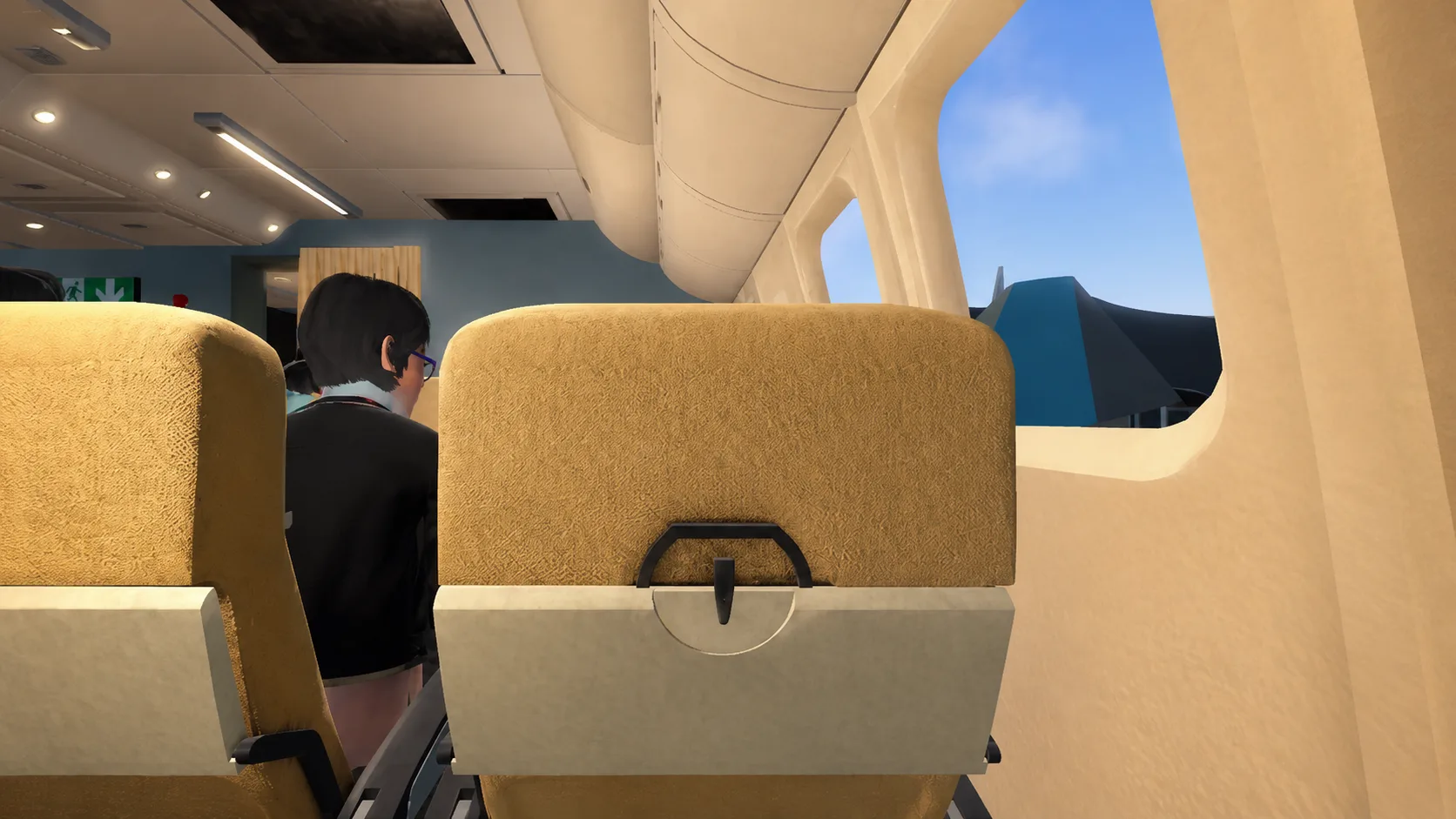
The hierarchy is built together with the patient and typically follows an ascending sequence. First, arrival at the airport, baggage check-in, and passing through security: contextual stimuli with no flight elements, useful for the first trials. Second, the boarding gate and sighting aircraft through the terminal windows, where the first anticipatory reactions appear. In VRET's Airplane flight environment the work starts seated in the cabin, so these first steps are usually covered through imaginal or in-vivo exposure.
Third, boarding the cabin, finding the seat, and door closure. Fourth, the taxiing sequence and takeoff roll, with its sound and vibration cues. Fifth, stable cruising flight, a phase many patients approach with the greatest negative anticipation. Sixth, turbulence graduated in intensity. Seventh, descent and landing.
Each step is worked through until the reported SUDS activation drops below an agreed threshold, typically 30 out of 100, and the patient can sustain it for at least five minutes without cognitive avoidance strategies. Only then does the protocol move to the next level.
An Example Session Structure Across 6-10 Sessions
A typical operational sequence includes one assessment-and-psychoeducation session, one session for headset habituation and testing the neutral scenario, four to six sessions of progressive exposure through the hierarchy levels, one consolidation session with turbulence and randomized variations, and a final relapse-prevention session with a real-flight plan.
Each exposure session runs between 45 and 60 effective minutes, with an initial SUDS calibration segment, a central immersion segment, and a closing segment in which the patient verbalizes their progress and records what was learned. Sessions are usually spaced weekly, although some patients respond better to an intensive format of two sessions per week over a month.
The psychologist records, in each session, peak SUDS, the latency to habituation, the most frequent intrusive cognitions, and the regulatory strategies used. This information feeds the hierarchy and guides the titration of the next session.
Session Closure, Transfer, and the Real Flight
Transfer to a real flight is the main criterion the professional uses to judge progress. After completing the VR hierarchy, it helps to propose a staged plan: a visit to the airport without boarding, a short accompanied domestic flight, an unaccompanied domestic flight, and finally an international flight or a flight with anticipated turbulence.
Relapse prevention includes a personal script with coping cognitions, a brief VR re-exposure routine before the real flight, and, when there is comorbid anxiety, a booster session at three months. Some published studies with 12-month follow-up have used similar components.
It is advisable to explicitly discourage occasional benzodiazepine use during real flights: they block the inhibitory learning that exposure has just built and increase the likelihood of relapse. If the patient requests them, it helps to reframe the role of medication within the intervention.
Cognitive Work During Exposure
The most frequent cognitions in aviophobia include 'the plane is going to crash,' 'I won't be able to escape if I feel bad,' 'I'm going to lose control and make a scene,' 'my body won't withstand the pressurization,' and 'something bad is going to happen and I won't be able to do anything.' Each one is addressed through prior identification, exposure during the session, and recording the observed outcome after the immersion.
In each session, the psychologist collects the patient's predictions about peak SUDS, the estimated duration of activation, the expected physical sensations, and the final subjective rating. Comparing these predictions with subsequent observation is one of the most powerful cognitive components of the protocol and consolidates a competing memory against the original belief.
It also helps to identify and discuss beliefs about anxiety itself ('anxiety proves something is wrong,' 'if I don't control it, it will become unbearable'). Reframing these metacognitions can help interrupt the interpretive spiral and support tolerance of activation during the real-flight phase, where the psychologist is no longer present in real time.
Integrating the Scenario into Practice
Integrating a VR fear-of-flying sequence into practice requires only a standalone headset, a stable internet connection, and an obstacle-free space of about two by two meters. The Airplane flight environment, with its graded flight phases and turbulence controls, lets the psychologist adjust intensity without leaving the office.
In VRET's Airplane flight environment, the professional chooses the flight phase (seated, takeoff, cruise, turbulence, descent, landing), continuous turbulence and sudden jolts, the window shade, weather, time of day, cabin occupancy, the seatbelt sign and captain announcements, with grounding audio available. Calming controls (calm the flight, emergency exit) are always at hand. The professional chooses, adjusts and controls the environment at all times.
The VRET team can walk you through the tool during onboarding. If you'd like to assess whether this environment fits your practice, you can book a demo with the team.
This article is for informational purposes for psychology professionals and is not clinical advice for any individual case. VRET is a support tool for professionals. It is not a medical device, does not diagnose or treat any disease and does not replace the judgement of the professional, who is responsible for its use.
Frequently asked questions
How many sessions do published fear-of-flying protocols with virtual reality use?
Protocols described in the literature usually range from six to ten sessions of about 50 minutes. The number in each case depends on initial severity, the presence of comorbidities, and the patient's availability for subsequent in-vivo exposure, and the professional decides it.
Can VR exposure be used if the person has never flown?
Prior flight history is not a requirement; what matters is whether the environment elicits the fear response during exposure. When the person has no flying experience, the professional can add psychoeducation sessions on flight mechanics and objective aviation safety data.
Can VR cause cybersickness in patients with fear of flying?
Cybersickness occurs in a minority of patients and usually resolves after two or three adaptation sessions. It helps to start with static scenarios before introducing takeoff and turbulence, and to plan frequent pauses during the first immersions.
Does VR exposure replace a real flight?
No. VR exposure is an intermediate step that prepares the patient for the real flight, which remains the ultimate transfer criterion. Some studies report better protocol adherence and lower dropout when both modalities are combined.
Can benzodiazepines improve the clinical outcome?
Published research indicates that benzodiazepines taken right before exposure can interfere with inhibitory learning. Their use is generally discouraged during exposure sessions, and during the transfer flight as well, unless the physician has prescribed them for a specific medical reason.
Is the cost covered by private health insurance?
Coverage depends on each insurer and how the service is categorized. It helps to present it as a cognitive-behavioral intervention that uses a VR support tool, not as an experimental technique, and to request prior authorization where applicable.
How do I tell fear of flying from claustrophobia?
With one screening question at assessment: what would happen if the aircraft were stationary on the ground, doors closed, with no prospect of taking off? If anxiety stays high, confinement weighs as much as or more than the flight, and the hierarchy must grade the enclosed space alongside the flight phases. If it drops clearly, it is aviophobia and the usual check-in, take-off, cruise and landing sequence is sufficient.
Keep reading
Fear of Driving After a Crash: Situational Fear or Post-Traumatic Presentation?
Fear of driving after a crash: the criteria professionals use to tell a situational fear from a post-traumatic presentation, what to address first, and how to build the driving hierarchy.
Situations and environmentsEnclosed-Space Exposure Hierarchy: Nine Graded Levels for Professionals
A nine-level hierarchy for working with fear of enclosed spaces, built on two independent axes, the differential with agoraphobia, and a brief format for people referred ahead of an MRI scan.
Situations and environmentsFear of Heights vs Vertigo: A Practical Differential for Psychologists
Fear of heights, vestibular vertigo and visual height intolerance get confused in practice. Five intake questions, two questionnaires and clear referral criteria for professionals.
VRET is a support tool for professionals. It is not a medical device, does not diagnose or treat any disease and does not replace the judgement of the professional, who is responsible for its use.