Virtual Reality for Psychology Practices: A Practical Guide for Professionals
By Equipo VRET
Virtual reality for psychology practices lets professionals present feared situations in a graduated, controlled way from within the practice itself, without the practical limits of in vivo exposure. This guide summarizes what it is, which situations professionals most often work with, what published research has examined, what it costs to set up, and how to integrate it into cognitive-behavioral exposure work without ever replacing your own professional judgement.
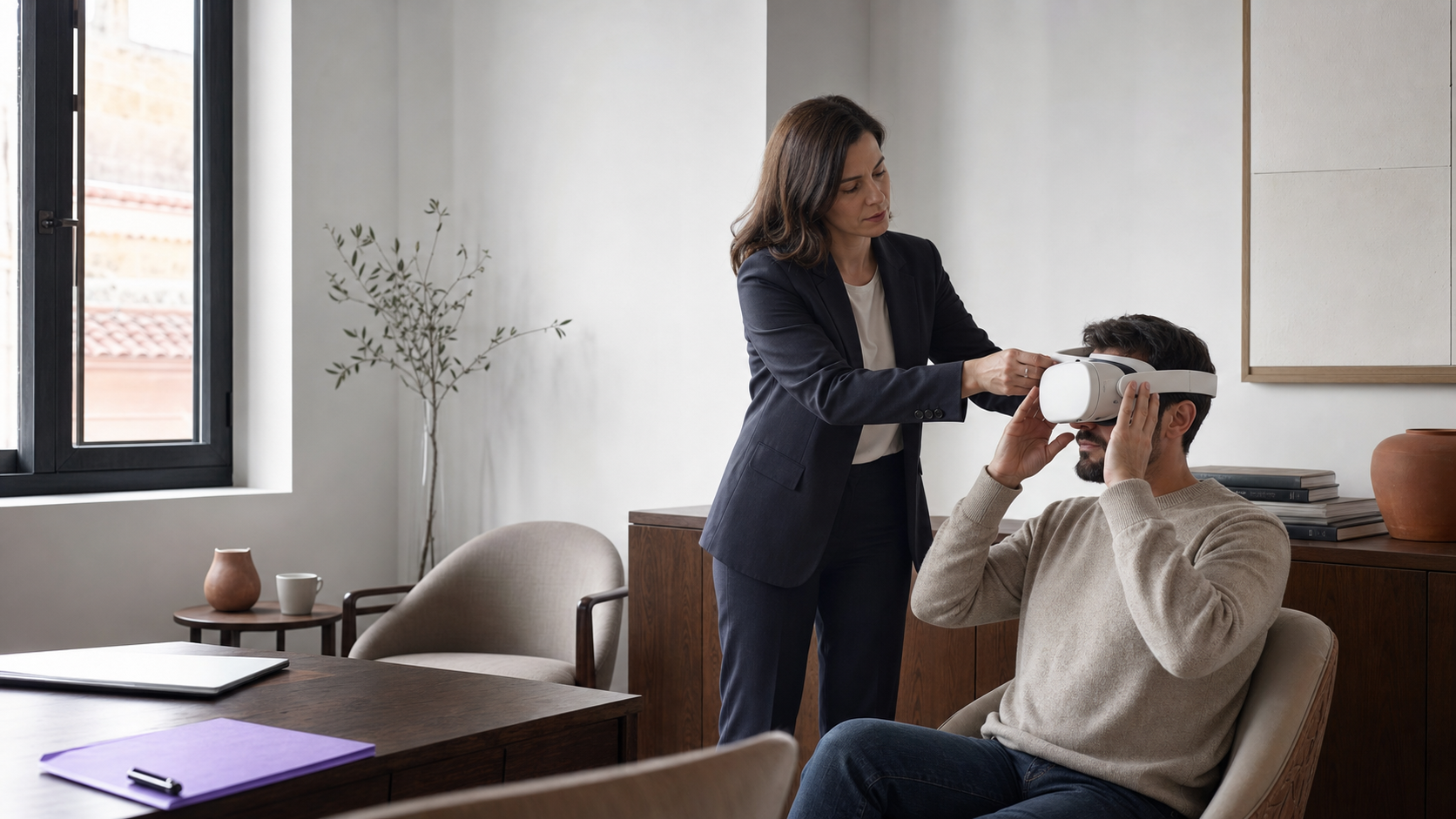
What Virtual Reality for Psychology Practices Is
Virtual reality for psychology practices is the professional use of computer-generated three-dimensional environments, presented through a headset, to present situations to the patient in a graduated way as part of exposure work. It is not entertainment or a technology demo: it is a tool at the service of the psychologist's judgement, used within a cognitive-behavioral approach that the professional designs.
Unlike imaginal exposure, the person doesn't have to mentally reconstruct the feared situation — they see it, hear it and perceive it as present. And unlike in vivo exposure, you control every variable from the practice: the height, the number of people, the intensity of the stimulus, or the exact moment the scene stops.
How a Session Works
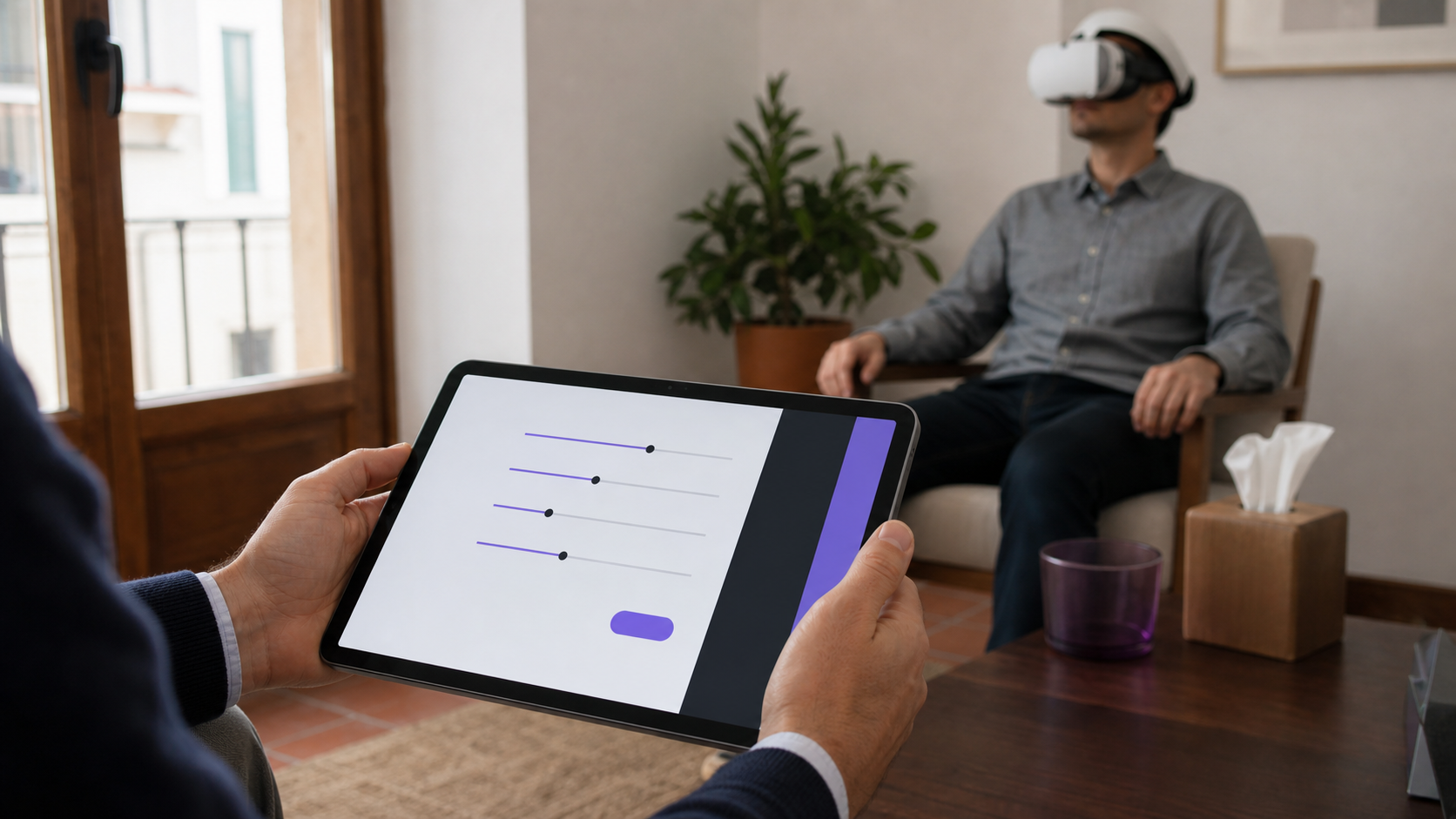
The patient puts on the headset and enters an environment that reproduces the relevant situation. From a control panel, the professional adjusts the parameters in real time and records subjective units of distress (SUDS) throughout the exposure. The professional can stop the session instantly with a single gesture if arousal exceeds the patient's window of tolerance. You can find a fuller account of the method in our guide to virtual reality exposure for professionals.
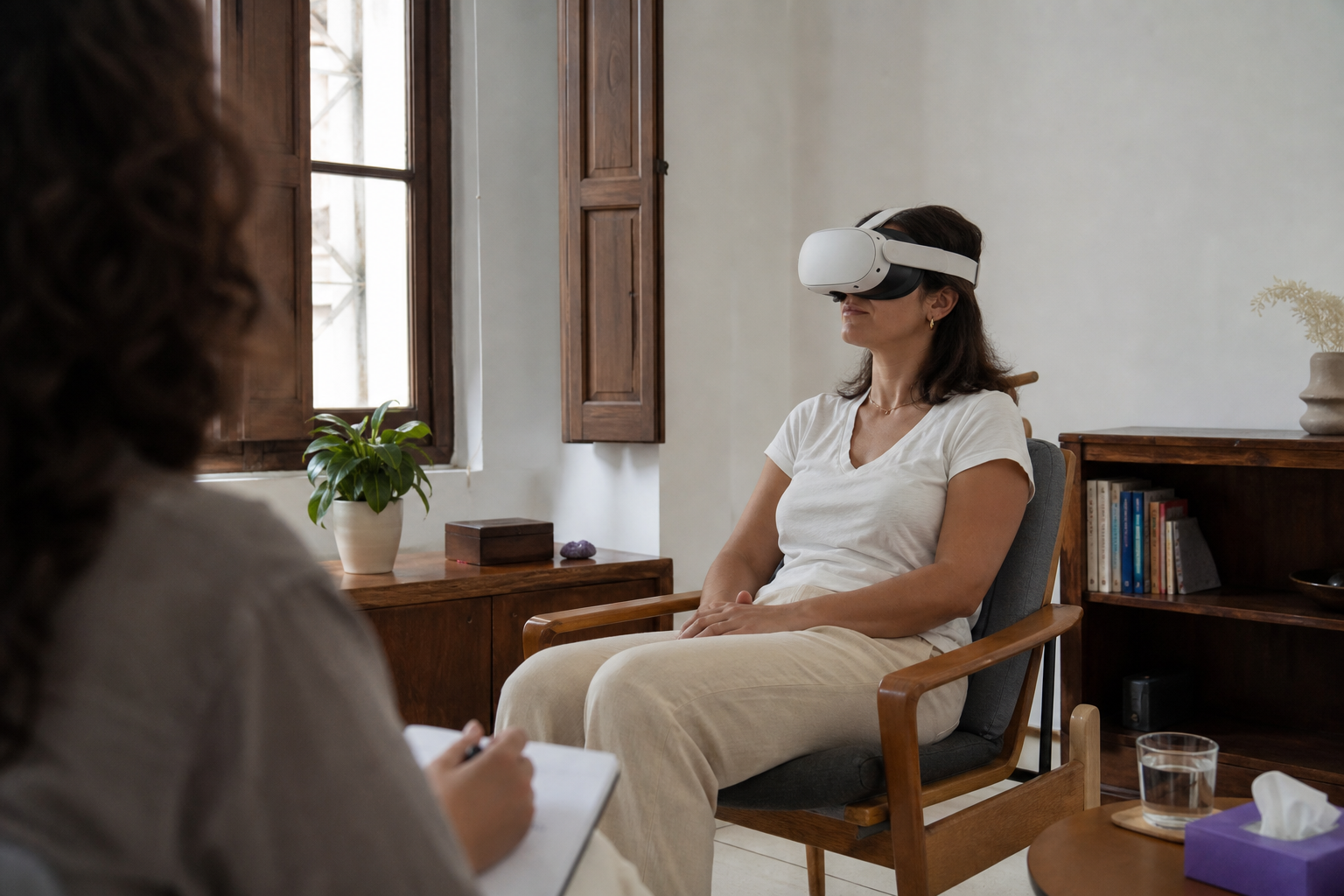
Which Situations Professionals Work With
Most of the published research focuses on fear and avoidance of specific situations. In practice, professionals use virtual reality for exposure work with situations such as heights, animals, flying and enclosed spaces, social situations, crowded places and public transport, and, with appropriate caution, situations related to a traumatic experience. You can browse the environments available in our scenario library.
The principle doesn't change from classic exposure: the professional builds a hierarchy of situations ranked by distress and progresses as habituation occurs. What VR adds is the ability to grade each step with precision and repeat the exposure as many times as the professional considers necessary — something almost impossible to organize with real-world stimuli.
It's worth being realistic about the limits. VR doesn't fit every presenting problem: its natural territory is progressive exposure, not pure cognitive restructuring or interventions that require genuine social interaction. A detailed example of this logic is in our step-by-step VR exposure hierarchy for an animal-related fear, which professionals can adapt as a template for other situations.
What Published Research Has Examined
Virtual reality has been used in psychology for more than 25 years, and its use in exposure work has been studied extensively. The meta-analysis by Powers and Emmelkamp (2008) compared VR exposure with in vivo exposure and with control conditions. Opriş et al. (2012) also looked at how results were maintained over follow-up.
One of the most-cited reviews is Carl et al. (2019), which pooled 30 randomized controlled trials with about 1,057 participants and compared VR exposure with control conditions and with in vivo exposure across several presentations. For specific fears, Parsons and Rizzo (2008) had published an earlier meta-analysis. These studies describe the technique in general; they are not a promise of results for any individual case.
One point that's relevant in practice is acceptability: some people who refuse in vivo exposure do accept starting in a virtual environment, which they perceive as safer and more controllable. The honest reading is that VR is not a shortcut to better outcomes than good in vivo exposure — what it adds is control, safety and reproducibility within the practice.
With this body of research, virtual reality has become an established resource within cognitive-behavioral exposure work, rather than a passing fad tied to consumer technology.
Advantages Over Traditional Exposure
Compared with imaginal exposure, virtual reality lowers the dependence on the person's visualization ability, which varies widely from person to person. The stimulus is standardized and reproducible, which makes it easier to compare sessions.
Compared with in vivo exposure, it avoids travel, protects confidentiality (there's no need to be exposed in a public place), and makes it possible to work with situations that are expensive or hard to access, such as a takeoff or a great height. It also improves safety: the professional can interrupt the scene instantly, without the contingencies of exposure out in the world.
The trade-off is that VR doesn't cover every sensory nuance of reality, and it's worth planning the final step to in vivo exposure when the professional considers it appropriate. It's an excellent bridge, not always the destination.
How It's Used in the Practice
The flow of a virtual reality session in the practice looks much like a conventional exposure session. You agree on the goal with the patient, select the environment that fits their hierarchy, run the exposure while tracking distress, and close with a debrief on what was worked on.
The operational difference lies in control: you can raise or lower the intensity without leaving the practice, pause the scene and resume it, or repeat a step as many times as needed. Continuous SUDS tracking throughout the session gives you a habituation curve that documents the session and helps you plan the next one.
Virtual reality for psychology practices really pays off when it's built into a stable working routine. If you want the step-by-step operational detail — physical space, first session and routine — we cover it in the guide on how to integrate virtual reality into your practice.
Cost and Return on Investment for the Practice
Setting up virtual reality for a psychology practice requires two elements: a standalone headset and professional software with environments and a control panel. The headset is a moderate one-time cost; the software is typically billed as a monthly subscription, which avoids a large upfront investment.
From a return-on-investment standpoint, VR lets you offer a differentiated service and bill the exposure session as a specific line item. It's worth running the numbers with real data from your practice — number of sessions, price per session and monthly cost — before deciding. You'll find the plans on the VRET pricing page and the equipment breakdown in our comparison of VR headsets for psychology practices.
How to Get Started and Precautions
To start using virtual reality in a psychology practice, you need prior competence in exposure techniques, familiarity with the headset and control panel, and careful case selection. VR is a tool within your professional judgement, not a substitute for assessment or the therapeutic relationship.
Precautions and Side Effects
Situations that call for caution include photosensitive epilepsy, advanced pregnancy, peripheral vertigo and migraine with aura; the professional weighs these case by case. The most common adverse effect is simulator sickness, which affects a share of users and tends to be mild and transient when the exposure is well graded and breaks are allowed. Any emotional discomfort is also a reason to pause.
As a reminder, VRET is a support tool for professionals: the decision to use it, the conduct of every session and the interpretation of what happens always remain the psychologist's responsibility. To organize the rollout, you can use our checklist for bringing VR into your practice.
This article is for informational purposes for psychology professionals and is not clinical advice for any individual case. VRET is a support tool for professionals. It is not a medical device, does not diagnose or treat any disease and does not replace the judgement of the professional, who is responsible for its use.
Frequently asked questions
Does virtual reality replace traditional psychological work?
No. It's a tool used within an approach designed by the psychologist, usually cognitive-behavioral. VR facilitates the exposure phase, but assessment, case formulation and the therapeutic relationship remain the psychologist's exclusive responsibility.
Do I need specific training to use virtual reality in my practice?
You need prior competence in exposure techniques and familiarity with the headset and control panel. It doesn't require advanced technical knowledge, but it does require professional judgement to select cases, build hierarchies and grade the exposure.
What equipment do I need to get started?
A standalone virtual reality headset and professional software with environments and controls from within your practice. The details on models, space and cost are covered in our guide on what you need to use virtual reality in your practice.
Is it safe for the patient?
Used under the professional's supervision and with careful case selection, most people tolerate it well. There are situations that call for caution (photosensitive epilepsy, advanced pregnancy, vertigo, migraine with aura) and one frequent, usually mild side effect, simulator sickness, which the professional manages by grading the exposure and stopping the scene when needed.
Which situations have been studied the most?
Most published studies focus on specific fears (heights, flying, animals, enclosed spaces), social situations and avoidance of crowded places and transport, often comparing VR with in vivo exposure. Work related to traumatic experiences has also been studied and calls for greater caution and professional experience.
Keep reading
Online Exposure Work: What Holds Up at a Distance and Where the Professional Limits Lie
How to tell a clinician-directed remote session from self-guided material and public apps, what professional support actually contributes, and which credentials authorise a professional to deliver exposure.
Practice managementContraindications to Exposure Work: Risks and Clinical Cautions for Professionals
Contraindications to exposure therapy as a technique, whether exposure can transiently raise distress, and when to postpone it: exclusion criteria and cautions.
Practice managementSUDS Scale: Recording Subjective Distress During Exposure
What the SUDS scale is, how professionals record self-reported distress during exposure, and which indicators actually show whether the work is moving.
VRET is a support tool for professionals. It is not a medical device, does not diagnose or treat any disease and does not replace the judgement of the professional, who is responsible for its use.