Meta Quest vs Pico vs Vision Pro: Best Clinic Headset
By Equipo clínico VRET
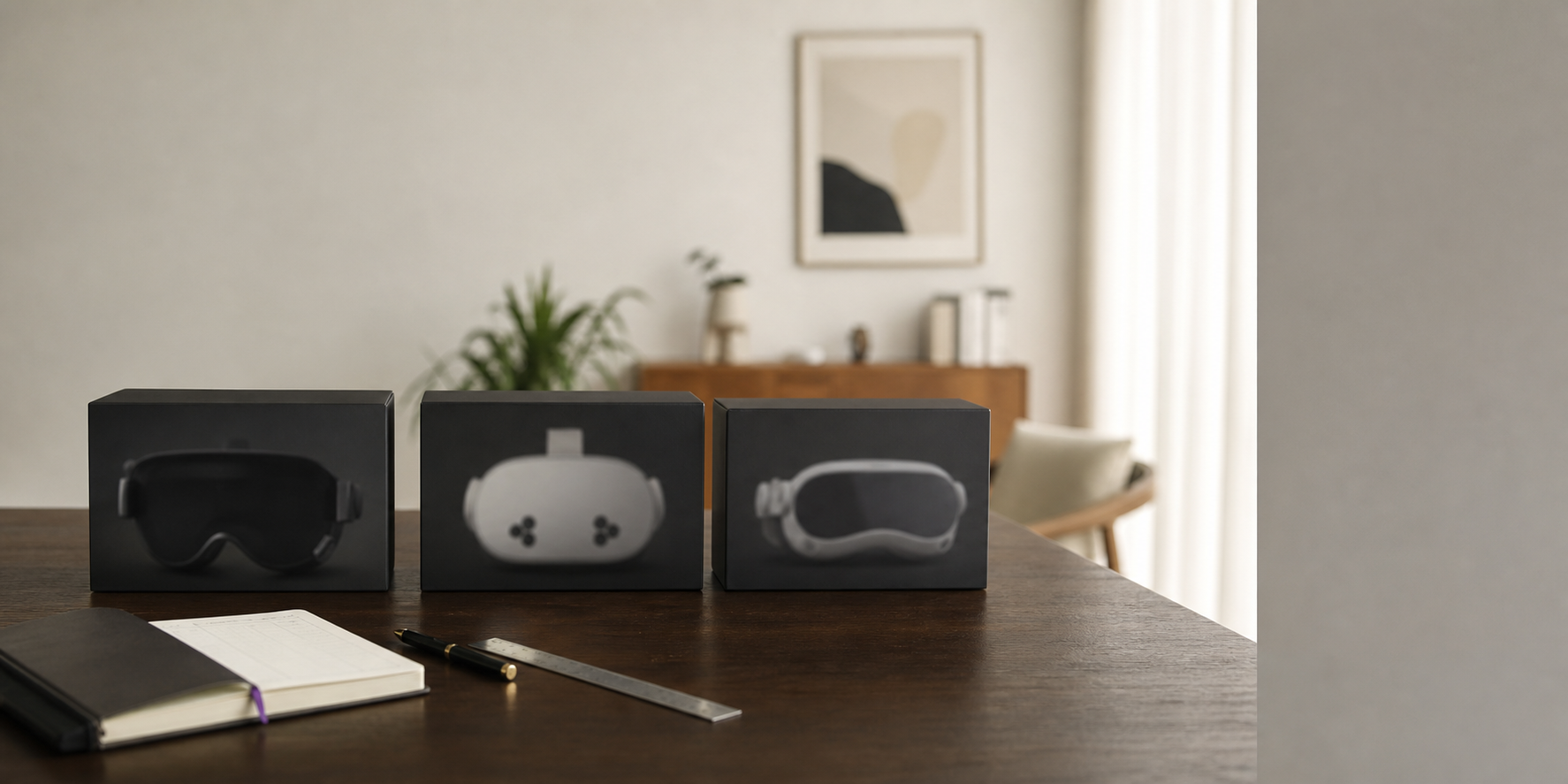
For most psychology practices in 2026, the rational choice is the Meta Quest 3 (~€549): standalone, lightweight, a broad clinical catalog, and mature ecosystem. Pico 4 Enterprise (~€900) makes sense with MDM management and fleet purchases of six units or more. Apple Vision Pro (~€3,999) is premature as a primary clinical tool: price, weight, and the lack of native therapeutic software rule it out for daily practice. PSVR2 on PC is a niche option for practices with strong computing equipment and a need for high-fidelity graphics, not a first headset.
Why This Article Exists
The most common question that reaches the VRET clinical team is not theoretical. It is operational: “if I buy a headset today, which one?” The average psychologist running a private practice in Madrid, Valencia, or Barcelona does not want a pixel-count comparison or a gaming review. They want to know which device will last five years in the consulting room, which vendor will answer the email when the headband breaks, and which headset will let them switch between patients every forty-five minutes without turning into an IT technician.
This comparison answers that specific question. It is not an exhaustive technical review. It is a clinical filter applied to the four headsets with real traction in the European psychology market as of May 2026.
The Four Real Candidates in 2026
Although the consumer market boasts dozens of models, in the clinical context only four have relevant installed volume in Spanish practices and a distributable catalog of therapeutic software.
Meta Quest 3 (released late 2023, still current as Meta's flagship for standalone use): a standalone headset with a Snapdragon XR2 Gen 2 processor, dual pancake displays at 2064 x 2208 per eye, 515 grams, 2 to 2.5 hours of battery life under intensive use, launch price in Spain around €549.
Pico 4 Enterprise (the enterprise version of ByteDance's Pico 4): the same base hardware as the consumer model but with device management via an MDM console, kiosk mode locked to a single application, direct commercial support, and a price of around €900 per unit for fleet purchases.
Apple Vision Pro (Apple, first quarter of 2024 in the US, available in Spain since 2025): a mixed-reality headset oriented toward productivity and audiovisual consumption, M2 + R1 chip, 600-650 grams with an external battery, price in Spain around €3,999.
PlayStation VR2 on PC (Sony, with the official PC adapter launched in 2024): a headset with inside-out tracking, OLED panels at 2000 x 2040 per eye, native eye tracking, requiring a computer with a mid-to-high-end GPU (RTX 4070 or better recommended), combined headset + PC price around €2,500-3,000.
Criterion 1: Total Cost of Ownership
The sticker price is not the real price. A practice that buys a headset amortizes it over three to five years. The correct calculation includes the device, predictable replacement parts (a premium strap, interchangeable hygienic facial foam, disposable covers if several patients are seen per day), insurance or extended warranty, and the cost of the associated PC if one is needed.
Meta Quest 3 comes to about €549 for the device plus €70-100 in hygiene accessories for the first year. Estimated year-one total: €650 per unit.
Pico 4 Enterprise comes to about €900 with an annual management license and enterprise support. Year-one total: €900-1,000.
Apple Vision Pro: €3,999 for the device plus a carrying case, additional straps (the main one gives out with prolonged use), and optional AppleCare. Year-one total easily exceeds €4,500.
PSVR2 + compatible PC: €600 headset + €200 PC adapter + €1,500-2,000 for a computer with an adequate GPU. Year-one total between €2,300 and €2,800, not counting the IT maintenance cost of the PC.
If your question is “how much does it cost me to put a headset in the therapy room per clinical hour,” the numerical answer is clear: Meta Quest 3 is five to seven times cheaper than Apple Vision Pro and two to three times cheaper than Pico Enterprise.
Criterion 2: Weight, Comfort, and Tolerable Session Length
A clinical exposure session lasts between twenty and forty-five minutes with the headset on. A guided relaxation or mindfulness session can run up to thirty. The actual weight on the face and the pressure on the bridge of the nose are decisive criteria, not cosmetic details.
Meta Quest 3 with the stock strap weighs 515 grams, and most adult patients tolerate it well for up to 30-40 minutes. The rigid Elite-style strap (an accessory) notably improves weight distribution and is recommended for practices running longer sessions.
Pico 4 Enterprise weighs about 295 grams at the front because it moves the battery to the back of the headband, balancing the weight. It is probably the most comfortable of the four for prolonged sessions, according to feedback gathered by European distributors.
Apple Vision Pro weighs 600-650 grams, and although the quality of the Solo Knit Band is high, front pressure is perceived as significant by adult users after more than thirty minutes of use. Apple includes an alternative Dual Loop Band to mitigate this.
PSVR2 weighs 560 grams with a halo strap similar to the original PSVR; it distributes weight well, but the cable to the PC limits the patient's freedom of movement in exposure scenarios that require turning the body.
Criterion 3: Available Clinical Software Catalog
A headset without therapeutic scenarios is an expensive paperweight. Here the asymmetry is stark.
Meta Quest 3 has the broadest clinical catalog on the market: Psious / Amelia VR, oVRcome, C2Care, gameChange (via licensed distribution), a third-party port of Bravemind, VRET itself, and mindfulness and relaxation solutions from dozens of developers. The reason is purely market-driven: Meta has sold more than 20 million Quest units, and developers publish first where the volume is.
Pico 4 Enterprise partially inherits the Quest catalog because many applications publish cross-compatible Android APKs, but the official distribution route is through the Pico Business Store, which is more limited and has a smaller native catalog. This gap will likely narrow during 2026 if Pico's enterprise push consolidates.
Apple Vision Pro has a nascent clinical catalog: as of May 2026, fewer than a dozen psychology applications have been published on visionOS, all in early-access or pilot phase. Apple has not prioritized mental health in its commercial messaging around Vision Pro.
PSVR2 on PC accesses the SteamVR catalog, where niche clinical software exists (some universities publish experiments) but none with robust commercial support. It is a research platform, not a clinical-practice one.
Criterion 4: Ease of Use for Non-Technical Staff
The psychologist at your practice does not want to be a systems administrator. They want to put the headset on the patient, start the scenario, and focus on the intervention.
Meta Quest 3 in standard use requires either the psychologist's personal Meta account or a (free) Meta for Work account, and the process from power-on to an active scenario takes under a minute if the application is preinstalled. The learning curve for front-desk staff is a single fifteen-minute session.
Pico 4 Enterprise with kiosk mode boots directly into the clinical application configured by the administrator. The psychologist only has to turn it on and hand it to the patient. It is probably the friendliest option for non-technical staff once configured, at the cost of a higher initial setup effort.
Apple Vision Pro requires an Apple ID, Optic ID setup (iris scan) for each user who will wear it, facial calibration, and individual adjustments. For a practice rotating through patients, the flow is cumbersome and breaks the therapy-room routine.
PSVR2 on PC requires Windows with SteamVR, up-to-date drivers, cable management, and a level of IT maintenance that falls outside the scope of the average psychologist.
Criterion 5: Real-World Durability in Practice
Clinical use is demanding: the headset goes in and out of its case up to five times a day, is handled by hands other than its owner's, and anxious patients can make sudden movements.
Meta Quest 3: the documented weak points are the stock fabric strap (which gives out after 6-12 months of intensive use, replacement €50) and the facial foam. The body of the device is reasonably robust. Expected lifespan in practice: 3-5 years.
Pico 4 Enterprise: hardware similar to the consumer model but with direct commercial support and enterprise RMA. Expected lifespan similar to Quest, with the advantage of a contractual SLA.
Apple Vision Pro: premium build quality, but the front glass and the laminated piece are fragile in a fall. The glass piece may not be coverable by independent repair.
PSVR2: the cable is the weak point. In clinical use with several patients a day, the cable is the first part to fail.
Criterion 6: Support and Vendor Presence in Spain
When something breaks, the question is who you call.
Meta has no dedicated clinical support channel in Spain. Support is standard B2C, via the web. Practices rely on specialized distributors or on their clinical software vendor (in VRET's case, our team provides first-line support for headset issues).
Pico has a network of enterprise distributors in Spain with a contractual SLA, RMA within 5-7 days, and a human point of contact. It is the strongest of the four on this criterion.
Apple has Apple Business, with physical stores in Spain, but Vision Pro as a healthcare-support device sits outside its commercial narrative. Support exists but is not specialized.
PSVR2: standard Sony support, with no clinical B2B component at all.
Recommendation by Practice Profile
A solo practice run by a licensed psychologist seeing one to three VR patients a day: Meta Quest 3. Minimal cost, maximum catalog, a flat learning curve. If the psychologist is reasonably comfortable with consumer technology, nothing more is needed.
A practice with several therapy rooms and a high patient rotation (more than ten VR sessions a day, several psychologists sharing headsets): Pico 4 Enterprise. MDM management, kiosk mode, and the support SLA make up for the higher price.
A practice with a university research profile, high-fidelity graphics needs, and ties to academic groups: PSVR2 + PC. Only if there is in-house technical competence to maintain the system.
Apple Vision Pro: as of May 2026, we do not recommend it as the main headset for a practice. It makes sense as a second unit for premium clinics that want to offer an occasional differentiated experience, or for pilot projects with external funding. The situation will likely change in 2027-2028 if Apple builds out a clinical catalog, but as of today the cost-benefit does not add up.
What Will Change in the Next 18 Months
Meta will likely unveil Quest 4 in 2026-2027 with improvements in weight and resolution. The catalog transition will be smooth.
Pico is pushing aggressively into Europe, with a growing presence at clinical trade fairs. Its enterprise catalog will likely grow.
An Apple Vision Pro 2 with a reduced price (rumored between €2,000 and €2,500) could change the calculation. Until it arrives and clinical software lands on the platform, the current recommendation stands.
Samsung and Google, with their new Project Moohan on Android XR, have not yet demonstrated any clinical traction.
What matters for today's decision-maker: buying a Meta Quest 3 in 2026 does not lock you in. The device amortizes in 18-24 months even under light use, and if the market pivots in two years, the sunk cost is manageable.
VRET and the Headset Choice
VRET, as clinical software, currently supports Meta Quest 3 as its primary platform and is working on compatibility with Pico 4 Enterprise. We do not publish on visionOS because of the clinical-catalog asymmetry described above. When a practice asks us which headset to buy, the default answer is Meta Quest 3, unless it has specific operational needs that justify Pico Enterprise.
This article is for informational purposes for psychology professionals. It is not clinical advice for any individual case and does not replace the judgment of the licensed psychologist in charge. VRET is professional clinical-support software, not a CE-marked medical device.
Frequently asked questions
Can I start with a single headset and expand later?
Yes, that is the typical pattern. Most practices start with a single Meta Quest 3 to test the use case in the therapy room for two or three months, and once the workflow is validated, decide whether to replicate the same model or move to Pico Enterprise for the fleet.
Does it make sense to buy a used headset to get started?
For an initial internal trial by the team, yes. For clinical use with patients, we do not recommend it: the facial foam must be new or certified interchangeable, and the manufacturer's warranty is valuable when the device breaks down after six months.
Do I need a powerful PC if I buy a Meta Quest 3?
Not for standalone use, which is the usual clinical case. The Quest 3 runs exposure and relaxation scenarios directly, with no PC required. You would only need a PC if you wanted to use the headset as a SteamVR peripheral for specific software, which is not the VRET workflow.
How do I manage hygiene between patients?
Interchangeable, washable silicone facial foam (a VR Cover-style model or similar) or disposable hygiene covers. Lens cleaning with a dry microfiber cloth. A written protocol posted in the therapy room. It is a five-minute operation per rotation.
How long does the battery last during a morning clinic schedule?
Meta Quest 3 gives about 2-2.5 hours of continuous use. For a schedule of five forty-minute sessions, that is just enough or a bit short. The operational recommendation is to plug in the headset between patients, or to use a certified power bank connected via USB-C for extended use.
Will Apple Vision Pro be worth it in 2027?
It probably will be, if Apple lowers the price and a native clinical catalog emerges. As of today, this cannot be stated with confidence. The recommendation is to revisit the decision at the end of 2026, once the visionOS roadmap and a possible second-generation device are known.
Keep reading
Will VRET Become First-Line Phobia Treatment in 10 Years?
A ten-year forecast for VR exposure therapy as first-line phobia treatment: research funding, regulation and the adoption trends clinics should watch.
Research & evidenceVRET Adoption in Spain 2026: Barriers and Opportunities
A data-driven look at VR exposure therapy adoption in Spanish clinics in 2026: usage rates, the barriers slowing growth, and what NHS and CleVR signal ahead.
Practice managementHow to Measure VRET Effectiveness in Your Practice
Validated tools for measuring VRET outcomes — BAI, LSAS-SR, FQ, IES-R, PCL-5, Y-BOCS, SUDS and IPQ — with a pre/post and follow-up protocol.
VRET is professional clinical-support software, not a CE-marked medical device. Clinical supervision remains with the licensed psychologist in charge.