Fear of Flying: Building a VR Treatment Service Line
By Equipo VRET
Of all the specific phobias, fear of flying packages best as a closed programme: demand arrives with a deadline, the patient is motivated by one concrete trip, and the outcome verifies itself. This article sets out the six-session structure, what virtual reality solves and what it does not, where the patients actually come from, and the usual mistakes in pricing a programme.
Why fear of flying packages as a closed programme
A psychology practice nearly always sells the same thing: individual sessions, of indefinite duration, with an outcome the patient cannot judge for months. It is a hard product to buy and a harder one to recommend.
Fear of flying breaks that pattern at four points, and they are worth taking separately because they are precisely what makes a closed programme viable:
- Demand arrives with a date. The patient does not come when distress accumulates; they come when there is a flight in the calendar. That turns a postponable decision into one with a deadline.
- The goal is concrete and shared. Not "feeling better": getting on that plane. Patient and clinician know from minute one what counts as success.
- The outcome verifies itself. Within weeks the patient either flies or does not. Few psychological interventions have an external measure that clean, and it feeds word of mouth naturally.
- The presentation is bounded. Absent significant comorbidity, session count is predictable, which allows a programme with a beginning and an end rather than an open-ended commitment.
None of these four properties is clinical: they are commercial properties of the presentation. And they are why fear of flying sustains an identifiable service line while other phobias, equally treatable, do not do so as readily.
The general reasoning on building a practice around one presentation sits in how to build a profitable phobia-specialty VR practice. What follows here is the specific application to aviophobia.
What the patient thinks they are buying, and what they need
There is a mismatch worth resolving on the first phone call, because otherwise it surfaces later as dropout.
The patient thinks they are buying a technique for not suffering on one particular flight. What they usually need is to stop organising their life around avoidance: the destinations written off, the meetings someone else attends, the holidays that are always by car. The request is one-off; the problem is chronic.
Handling that badly has two versions. Promising only the flight leaves the patient with no reason to continue once they land, and the pattern returns. Pressing the underlying problem before they ask turns an easy decision into an open-ended therapeutic commitment, and many will not take that step.
The formulation that tends to work is sequential: the programme is designed for that flight, and in the closing session you review which behaviours the patient still avoids and offer continuity if they want them back. You deliver what was promised and open the door without forcing it.
One important nuance for the initial assessment: ask explicitly about claustrophobia. A proportion of patients who present with fear of flying do not fear the flight itself but being shut in a space they cannot leave for hours. The plan changes substantially, and the work then leans on the claustrophobia exposure hierarchy as much as on the flight sequence.
Structure of a six-session programme
Six sessions is the format that best balances clinical sufficiency against a reasonable purchase. Fewer leaves generalisation out; more starts to read as open-ended therapy and loses the advantage of being closed.
- Assessment and formulation. Flight history, current avoidance, screening for claustrophobia, panic and comorbidity. Date of the target flight. Explicit agreement on what counts as the outcome.
- Psychoeducation and regulation. How the anxiety response works, what turbulence is in physical terms, what noises an aircraft makes and when. Paced breathing training belongs here; cardiac coherence and VR covers the pre-exposure regulation work.
- Exposure to the pre-flight phase. Airport, check-in, security, departure gate. It generates the most anticipatory anxiety and is the phase most often skipped.
- Boarding, taxi and take-off. Take-off concentrates the peak for most patients.
- Cruise and turbulence. With turbulence graded by intensity. The goal is not tolerating maximum buffeting but disconfirming the specific prediction the patient makes about what it means.
- Full flight and closure. The entire sequence uncut, a written coping plan for the real flight, and a review of outstanding avoided behaviours.
Two frequent adjustments. If the target flight is less than three weeks away, compress sessions 3 and 4 and prioritise 5. If there is associated panic, the programme runs longer, and that should be said before taking payment rather than after.
The full clinical description of the sequence is in the VR exposure therapy protocol for fear of flying.
What virtual reality solves in fear of flying, and what it does not
The boundary is worth being clear about, because whether the programme holds up or gets oversold depends on it.
What it solves. The logistical problem, which in this phobia is decisive. There is no way to expose a patient to take-off twenty times in a row. In-person airline courses offer one flight, at the end, once. Virtual exposure allows the critical phase to be repeated as often as needed, graded and stopped, which is exactly what a properly conducted exposure procedure asks for.
It also solves a non-trivial scheduling problem: the whole programme fits inside the consulting room, with no travel and no third-party coordination.
What it does not solve. Irreversibility. In the virtual scenario the patient knows they can take the headset off; on a real flight they cannot get off. That difference is real and is not eliminated but worked with: addressed explicitly in the closing session and built into the coping plan.
Nor does it solve comorbidity. A patient with panic disorder and fear of flying needs interoceptive work that situational exposure does not cover.
Being explicit about this limit at the first consultation improves adherence, because it stops the patient reading residual anxiety on the real flight as treatment failure.
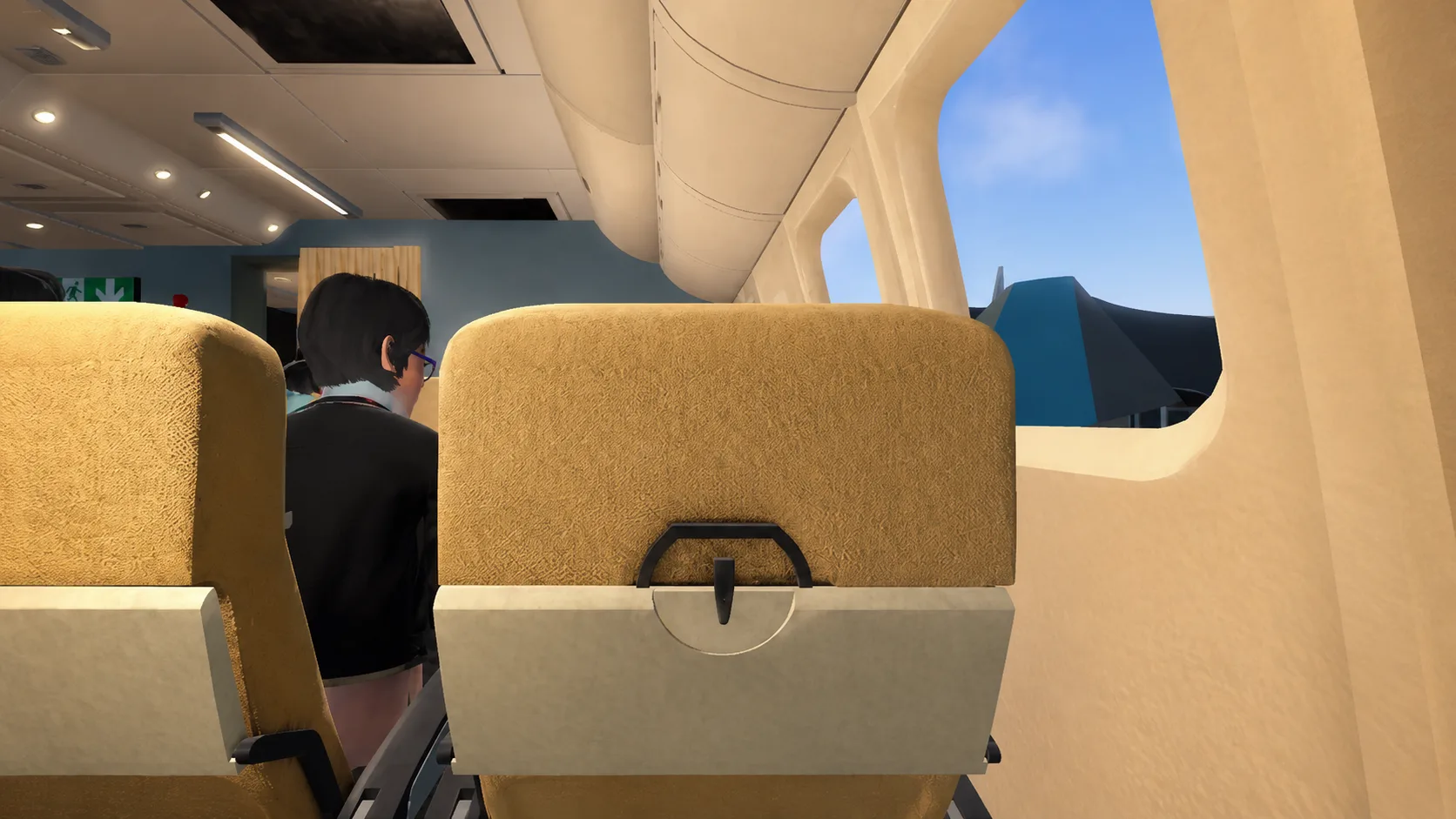
In the VRET fear of flying scenario, flight phase, turbulence intensity, weather and cabin sound are controlled separately from the clinician panel.
Where the patients come from
A service line with no intake route is a leaflet. These are the four that work, ordered by activation effort.
Local search intent. Demand for this presentation is searched by city and with urgency. A dedicated service page explaining the programme, its duration and what it includes captures the person who has already decided to seek treatment.
General practice and insurers. The patient with fear of flying has usually already been to their doctor asking for something to take on the flight. It is a natural and lightly contested referral; how to build a referral network with GPs, psychiatrists and insurers covers how to open it.
Companies with business travel. The least-worked route and the highest value per patient. A professional who cannot fly has a concrete work problem, and their people team has both budget and an interest in solving it. A closed programme, with known duration and price, is exactly the format a company can approve.
Travel agencies. They see the objection at the precise moment it appears. It takes upkeep, but referral quality is high because the trip is already half decided.
A note on airline courses: they are not direct competition, they are a channel. They cover psychoeducation and a final group flight, and work well for mild fear. The patient with consolidated avoidance rarely signs up, and the one who signs up and does not finish is a clear candidate for individual treatment.
Pricing a programme rather than a session
The commonest error in building this line is packaging the programme and then invoicing it as six separate sessions. The whole advantage is lost: the patient re-decides every week whether to continue, and the outcome conversation fragments.
Four things worth settling before publishing anything:
- A price for the whole programme, not a per-session price multiplied by six. They are different things and patients read them differently.
- Exactly what it includes: number of sessions, initial assessment, written coping plan and, where appropriate, a post-flight review.
- What happens if the flight is cancelled or moved. It happens more than you would expect, and without a policy set in advance it resolves badly.
- The referral criterion. Which findings at initial assessment take the patient out of the closed programme and into open-ended treatment. Worth having in writing before it happens.
On actual figures, what to charge for a VR session in private practice sets out market ranges and the reasoning for positioning within them.
And one caution that is ethical rather than commercial: a closed programme describes a procedure and a duration, never an outcome. The difference between "six sessions of structured exposure" and any formulation promising the patient will fly without anxiety is not a matter of nuance.
Before you advertise the programme
Three checks that prevent most first-quarter problems.
Run the whole thing yourself. All six sessions, headset on, stopwatch running. You will find out where your time actually goes and which panel controls you really use. It is the difference between selling a programme and selling the idea of one.
Have the exclusion criteria written down. Comorbidity that forces the patient out of the closed format, contraindications for headset use, and what you offer instead. Improvising it in front of the patient is expensive.
Decide how you measure. One instrument at intake and at discharge, plus the behavioural datum, which in fear of flying is binary and honest: they flew or they did not. Without a measure there is no case to tell the next referrer. The clinical VR software comparison covers what each tool records per session.
This article is for informational purposes for psychology professionals. It is not clinical advice for any individual case and does not replace the judgment of the licensed psychologist in charge. VRET is professional clinical-support software, not a CE-marked medical device.
Frequently asked questions
Why does fear of flying work as a closed programme when other phobias do not?
Because of four properties of the presentation that are commercial before they are clinical: demand arrives with a date because there is a flight in the calendar; the goal is concrete and shared from the first session; the outcome verifies itself within weeks; and absent comorbidity the session count is predictable. Other equally treatable phobias lack the external deadline that turns a postponable decision into a dated one.
How many sessions should the programme include?
Six balances clinical sufficiency against a reasonable purchase: assessment, psychoeducation and regulation, the pre-flight airport phase, boarding and take-off, cruise and turbulence, and a full flight with closure. Fewer loses generalisation; more stops reading as closed. If the target flight is under three weeks away, compress the middle sessions.
What if the patient actually has claustrophobia?
Detect it at initial assessment, because it changes the plan. A proportion of those presenting with fear of flying do not fear flight but being shut in a space they cannot leave for hours. In that case the work leans on a confinement hierarchy as much as on the flight sequence, and a closed six-session programme may fall short.
Are airline fear-of-flying courses competition?
They work more as a channel than as competition. They cover psychoeducation and a final group flight, and handle mild fear well. The patient with consolidated avoidance rarely signs up, and the one who signs up and does not finish is a clear candidate for structured individual treatment.
How do you price it without promising outcomes?
By pricing the procedure and its duration, never the result. A programme is described by what it includes: number of sessions, initial assessment, a written coping plan and a follow-up review where appropriate. Settle in advance what happens if the flight is cancelled, and which assessment findings take the patient out of the closed format.
Keep reading
Standing Out From Other Practices in Spain With VRET Tech
Web positioning, referral relationships and patient messaging: how to build a real differentiator with VR without falling into empty promises.
Software comparisonsHow to Build a Profitable Phobia-Specialty VR Practice
A practical model for a phobia-specialty VR practice: wide-reach patient acquisition, hybrid care, and the caseload needed to stay profitable.
Software comparisonsAttracting Gen Z Patients: Technology as a Selling Point
How Gen Z and millennial patients research psychologists online before booking, and how VR technology and a clean digital presence sway their decision.
VRET is professional clinical-support software, not a CE-marked medical device. Clinical supervision remains with the licensed psychologist in charge.