VR Mindfulness: Immersive Nature Environments for Professional Practice
By Equipo clínico VRET
VR mindfulness combines two lines of research: attention training and exposure to restorative natural environments (beaches, forests, mountains). Published studies have examined physiological markers (cortisol, heart rate) and mood after brief sessions, with modest findings. It is not a stand-alone intervention: the professional uses it as a complement to psychotherapy and to the person's own practice. This article explains what it does and does not offer.
Why Combine Mindfulness and Virtual Reality
Mindfulness, understood as the practice of non-judgmental attention to the present moment, has been integrated into evidence-based psychotherapy for more than four decades. Programs such as Kabat-Zinn's Mindfulness-Based Stress Reduction (MBSR) and Segal, Williams, and Teasdale's Mindfulness-Based Cognitive Therapy (MBCT) have been studied extensively in relation to stress, relapse prevention in depression, and management of chronic pain.
In parallel, research on exposure to natural environments (referred to in the literature as nature exposure or green exposure) has documented positive effects on salivary cortisol, heart rate, blood pressure, and subjective mood. Work by Browning, Yeo, and other authors suggests that even virtual nature (video imagery or VR environments) reproduces part of these restorative effects.
Virtual reality makes it possible to combine both elements: an immersive natural environment (a forest full of ambient sound, a beach at sunrise) where mindfulness can be practiced with fewer distractions than in the consulting room, without traveling to a real-world setting. For many patients living in cities, this lowers the barrier to entry for the practice.
What Published Studies Report
Research specifically on mindfulness in virtual reality is still relatively young, but the findings converge in a reasonable direction. Available systematic reviews describe modest but consistent changes in acute stress measures (cortisol, state-anxiety scales) following single sessions of virtual nature lasting 5 to 20 minutes.
For longer programs (several sessions over multiple weeks), the effects accumulate, especially when combined with guided mindfulness instructions and personal practice between sessions. Direct comparisons with conventional mindfulness programs are still scarce.
It is worth noting that many studies have small samples, short follow-up periods, and limited active comparators. This line of research is promising but does not yet allow definitive conclusions about the superiority of the VR version over traditional practice.
Which Environments Are Typically Used
Platforms in this field, VRET among them, offer a catalog of environments for mindfulness practice. Common settings include forests with ambient sound and changing light, beaches at sunrise or sunset with the sound of waves, mountain meadows, calm lakes with morning mist and gardens. In VRET's relaxation and mindfulness group, examples are Relaxation — Mindful Park Walk, Relaxation — Mindful Beach Walk, Relaxation — Mindful Bamboo Forest Walk, River Valley Walk and Relaxation — Sunset Coast.
The design criterion is to maximize the sense of restorative nature without cognitively demanding elements (no tasks, no goals, no scores). Spatial sound is important: birdsong, wind, and water are all positioned to reinforce the sense of presence.
Some environments include a soft guiding voice that leads the mindfulness practice step by step. Others are used in silence or with recordings made by the psychologist, depending on each professional's style.
What a guided nature walk scenario looks like from the inside
The label "immersive nature environment" hides the design decisions that determine whether a scenario is usable in session or stays a pretty demo. They are worth spelling out, because they are exactly what to ask any vendor before buying.
The patient does not drive the movement. In a guided walk the route advances on its own, at a constant pace along a fixed rail. That is deliberate: if the patient steers with controllers, attention goes to the motor task and the very thing you are training disappears. Passive, slow movement also reduces the sensory conflict that causes motion sickness.
The route has stops; it is not a video. The useful structure is a sequence of points of interest where movement halts and a short prompt enters: attend to the sound of the water, notice the contact of your feet, follow the movement of the leaves. Between stops there is silence, and that silence is part of the exercise rather than a gap to fill.
The narration can be switched off. A patient with prior practice usually prefers the environment without a voice; a beginner needs the guidance. If the voiceover cannot be decoupled from the scenario, you lose half your cases.
Duration governs content. Half an hour of route is not thirty minutes of stimuli: it is a sustained pace with very little variation. The temptation to add wildlife, changing weather and events runs directly against what an attention exercise requires.
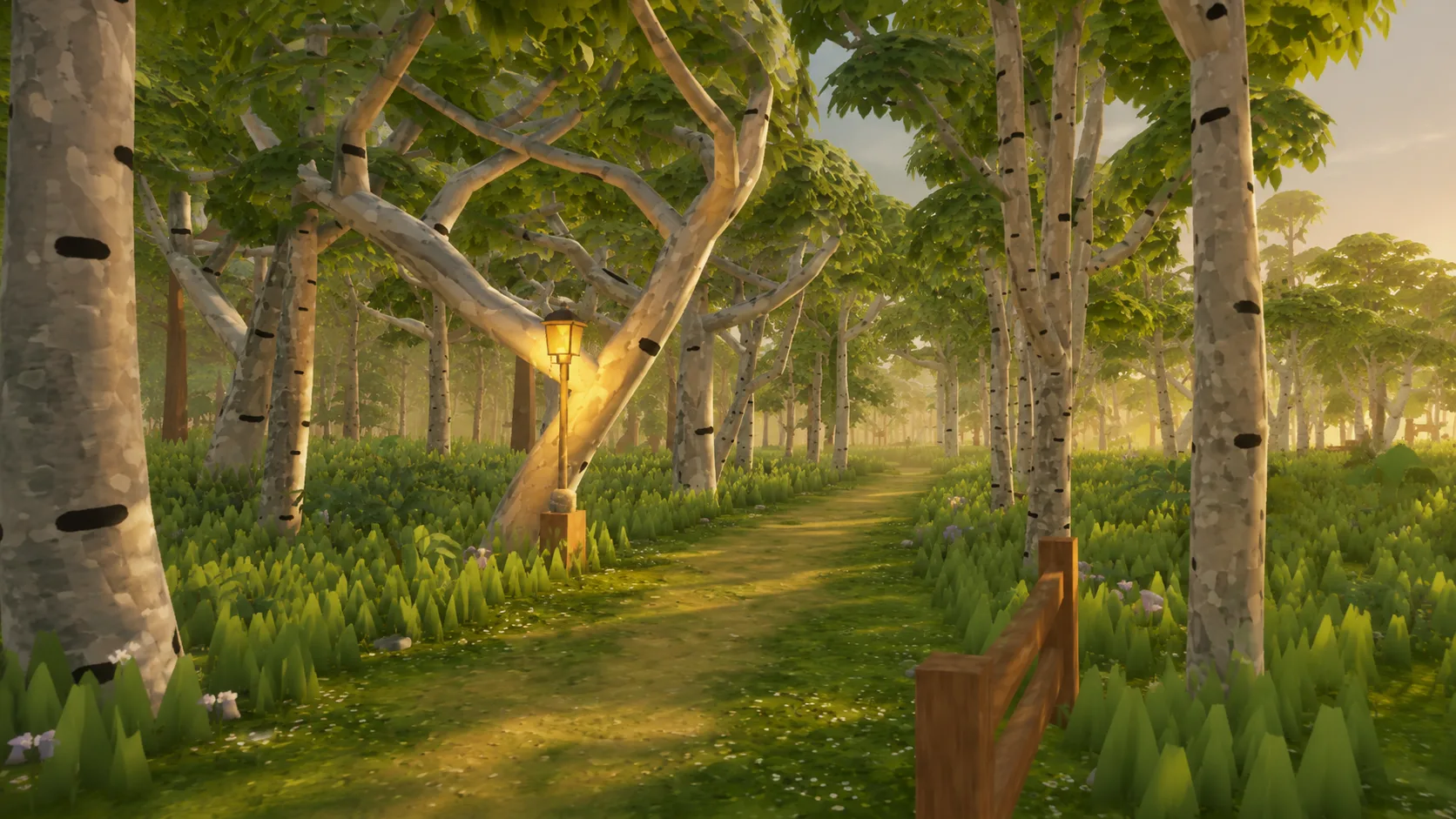
In the VRET catalog this corresponds to Relaxation — Mindful Park Walk: a voice-guided route through a park at dawn that advances on its own, with stops in seven zones (grounding, mindful walking, sensory attention, defusion, letting go, body scan and closure). The professional picks the narrator voice and the duration (10 to 21 minutes) and adjusts the walk pace, time of day and volumes; there is a reduced-motion mode and no exposure stimulus at all. It sits alongside the rest in the VRET environment catalog.
Use Within the Clinical Session
In the consulting room, VR mindfulness can serve several purposes: as preparation before an exposure session (to reduce baseline arousal and facilitate the work that follows); as an in-session regulation technique (if arousal during an exposure becomes too intense and a pause is warranted); and as explicit training of attentional skills (when the person has concentration difficulties or a tendency toward rumination).
The psychologist decides the duration (typically 5 to 15 minutes), the environment, and the degree of guidance. The session usually closes with a brief reflection on the experience and on how to apply what was learned outside the consulting room.
Three moments of use are worth separating, because they pursue different things and are not equally advisable.
Before exposure. The most valuable use and the least exploited. It places the patient inside their window of tolerance, doubles as headset acclimatisation with an environment carrying no emotional load, and lets you rule out motion sickness before it gets confused with phobic arousal. In the professional's judgement, a patient who enters the hierarchy already regulated may tolerate higher levels in the same session. The breathing work for this phase is developed in cardiac coherence and VR: regulating patients before exposure.
During exposure. One important caveat here: inserting relaxation mid-trial can function as a safety behaviour and block disconfirmation of the expectancy. The exception is clinical de-escalation, where the professional pauses the stimuli to bring down the arousal of a patient who has moved outside the working window. That is not a break; it is a manoeuvre with a beginning and an end decided by the clinician.
At closure. A few minutes of neutral environment help the patient leave the room in a different state from the exposure peak. It is a minor use, but it can improve how the session is remembered and adherence to the next one. An environment where this sequence matters particularly is Enclosed spaces — Residential elevator.
Use Outside the Session
Some practices using VRET set up a protocol in which the patient can practice VR mindfulness outside of formal in-person sessions, either by visiting the practice between scheduled sessions or, in some pilot cases, with headsets provided temporarily for supervised at-home use. VRET's mobile app also lets the professional assign relaxation and mindfulness practice between sessions.
This second modality is interesting but requires precautions: psychologist supervision of the instructions, clear usage protocols, and avoidance of compulsive use or use as a substitute for other practices. Virtual reality should not become an avoidance behavior or a routine isolated from the therapeutic framework.
For patients who already have an established mindfulness practice, VR can be an occasional complement for especially difficult sessions or to reinforce motivation. For those just starting out, it is best combined with traditional, technology-free practices.
What VR Mindfulness Is Not
It is important to calibrate expectations. VR mindfulness is not a stand-alone intervention for clinical conditions. It does not replace psychological work on depression, clinical anxiety, personality disorders or trauma. It is a complementary technique the professional can include in a broader intervention plan.
Nor is it a quick fix for work or life stress. Mindfulness practice, whether with or without VR, requires consistency. Isolated sessions can generate momentary well-being, but lasting effects come from sustained repetition.
And, obviously, it is not a virtual escape from real life. The goal of the practice is to develop attentional and regulation skills that apply to daily life, not to create a dependency on the virtual environment as a refuge.
Differences Between VR Practice and Traditional Meditation
Traditional mindfulness practice is usually done with eyes closed or gaze lowered, in a tidy, quiet physical space, without additional visual stimuli. VR practice keeps the eyes open within a virtual environment rich in natural sensory stimuli.
This has both advantages and drawbacks. The advantage is that it lowers barriers to access for many people: the virtual environment offers a concrete sensory anchor for attention to rest on, which helps those who find it difficult to meditate with closed eyes or in everyday spaces. The drawback is that it adds a sensory layer that traditional practice does not include, and some professionals argue that this can distract from introspection.
Both modalities can coexist. A balanced clinical practice will use VR as an occasional complement, without expecting it to replace traditional meditation. The ultimate goal is the same: to develop the capacity to attend to the present with openness and acceptance.
Clinical Situations Where It Is Used Most
VR mindfulness finds applications in several specific clinical situations: as support for managing work or academic stress, for example in adjustment problems; as a regulation tool before intense exposure sessions, for instance in trauma-focused work or severe social anxiety; and as a component of chronic pain programs, where mindfulness has been widely studied.
It is also used with hospitalized patients or those with reduced mobility who cannot access real natural environments and for whom the restorative component of immersive nature may be valuable. In oncology, for example, there are research lines exploring its use as support during long medical procedures.
For the general non-clinical population, VR mindfulness can be an entry point into the practice, without being intended to replace structured programs such as MBSR or MBCT when the professional considers them appropriate.
Precautions and Safety Considerations
The safety profile of VR mindfulness is good, but certain considerations apply. Motion sickness can occur in susceptible individuals, especially with environments that include movement. Some people with a history of severe trauma may experience unexpected reactions when immersed in intense sensory stimuli (even in peaceful environments); this is addressed through prior preparation and gradual exposure to the headset.
Mindfulness itself, in a small proportion of practitioners, can trigger difficult experiences (negative affect, intrusive memories). In a clinical context, this is identified and managed. Outside a therapeutic framework, caution is warranted, especially for people with relevant psychopathological history.
If you are considering VR mindfulness for your practice, assess each person's history and tolerance before the first session and keep the practice within your clinical framework.
This article is for informational purposes for psychology professionals and is not clinical advice for any individual case. VRET is a support tool for professionals. It is not a medical device, does not diagnose or treat any disease and does not replace the judgement of the professional, who is responsible for its use.
Frequently asked questions
Is VR mindfulness the same as meditation apps?
Not exactly. Apps offer guided audio without an immersive visual component. VR adds the full natural environment, with spatial sound and a sense of presence, which reduces distractions from the usual physical surroundings.
How long do typical sessions last?
Usually between 5 and 20 minutes. Longer sessions are possible but tend to be reserved for people already accustomed to the practice and to using the headset.
Is it suitable for people who have never practiced mindfulness?
Yes, it tends to be an accessible way to get started, especially for people who find it hard to concentrate in everyday settings. Even so, it should be combined with proper instruction so the practice does not stop at the sensory component.
What do studies report about stress measures?
Published research describes modest but consistent changes in physiological and subjective markers following single sessions. Any sustained effect is linked to regular practice.
Can it create dependency on the headset?
If used occasionally and within a therapeutic framework, this is not common. If it becomes a substitute for everyday emotional regulation or other practices, the usage should be reconsidered.
Can it be used with people experiencing depression?
It can be part of a broader intervention. As an isolated technique, it is not considered an intervention for clinical depression on its own. Whether it is appropriate is decided by the psychologist in charge.
Is there a risk of reliving trauma during the practice?
In a minority of people, states of stillness and self-contact can activate difficult content. In a clinical context, this is anticipated and managed. Outside a therapeutic framework, caution is advised.
Does a person need a headset at home to practice?
No, it is not necessary. Most patients access the headset at the practice. Some pilot protocols allow supervised at-home use, but this is not yet common practice. Between sessions, the professional can assign relaxation and mindfulness practice through VRET's mobile app.
How is a relaxation scenario different from a 360º nature video?
In the degree of control the professional has. A video plays identically for everyone and cannot be halted at a specific point or re-paced. An environment designed for clinical use can let the professional choose the narration, fit the duration to the session and adjust the pace of the route. Slow, passive movement and a reduced-motion mode also help limit motion sickness, which a video shot in motion does not control for.
Keep reading
Online Exposure Work: What Holds Up at a Distance and Where the Professional Limits Lie
How to tell a clinician-directed remote session from self-guided material and public apps, what professional support actually contributes, and which credentials authorise a professional to deliver exposure.
Practice managementContraindications to Exposure Work: Risks and Clinical Cautions for Professionals
Contraindications to exposure therapy as a technique, whether exposure can transiently raise distress, and when to postpone it: exclusion criteria and cautions.
Practice managementSUDS Scale: Recording Subjective Distress During Exposure
What the SUDS scale is, how professionals record self-reported distress during exposure, and which indicators actually show whether the work is moving.
VRET is a support tool for professionals. It is not a medical device, does not diagnose or treat any disease and does not replace the judgement of the professional, who is responsible for its use.