VR for Psychologists: Uses in Practice and What the Research Says
By Equipo VRET
VR for psychologists is, above all, a way of carrying out exposure work with a level of control that classic practice doesn't allow: the tool provides the environments and the controls, and the professional chooses, adjusts and controls each session. This article explains what it adds compared with imaginal and in vivo exposure, which situations professionals work with, what published research has examined over more than 25 years, and what skills you need to bring it into your practice with sound judgement.
What VR for Psychologists Actually Is
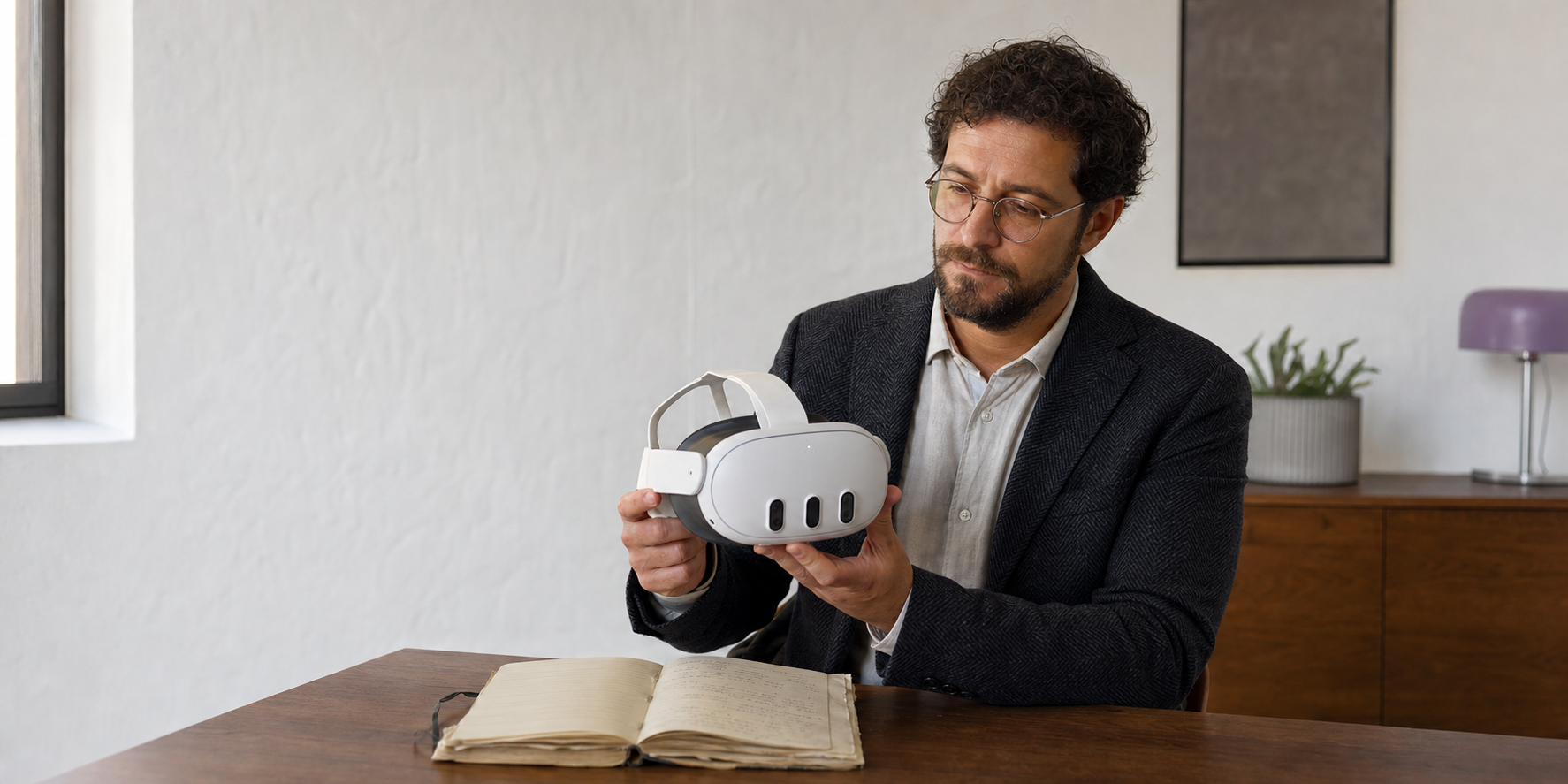
When we talk about VR for psychologists, we don't mean a video game or a consumer gadget: we mean a professional tool, three-dimensional environments that reproduce feared situations, which the psychologist uses to run graded exposure from the consulting room.
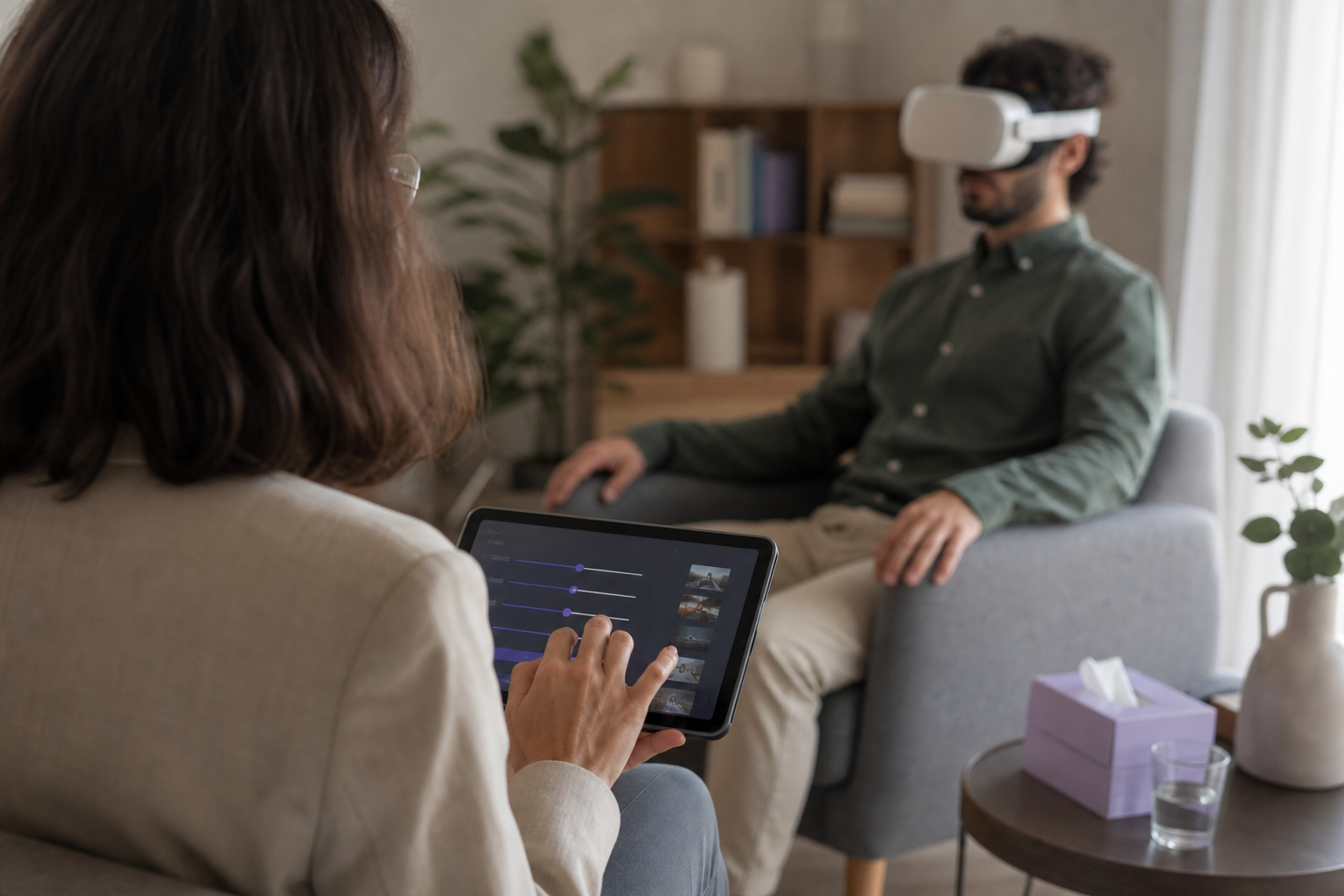
The person puts on a headset and enters a scene (a height, an animal, a flight, a room full of people) while the psychologist runs the session from a control panel, adjusting intensity and recording SUDS ratings. All of the clinical weight still rests on the professional's judgement; the technology only supplies the stimulus.
Put differently, VR for psychologists is a way to apply a principle you already know: graded exposure, a technique with a long history in cognitive behavioral psychology. For a broader overview, read what virtual reality exposure is.
How It Differs from Imaginal and In Vivo Exposure
Imaginal exposure depends on the person's ability to visualize, which varies widely. A virtual environment removes much of that dependency: the stimulus is external, standardized and reproducible, which also lets the professional compare the person's response from one session to the next.
Compared with in vivo exposure, the advantage is control. The professional can raise the height floor by floor, decide how many people are in a room, or stop the scene instantly, without the contingencies of a real environment. This makes it possible to work with situations that are expensive, risky or hard to access, and it protects the person's privacy, since they don't have to expose themselves in public.
The honest trade-off is that VR doesn't reproduce every sensory nuance of the real situation. That's why, when the case allows it, many professionals plan a final step into in vivo exposure. VR can work as a bridge toward that transfer.
There's a third factor, less often discussed but important in practice: acceptability. Some people who refuse to face in vivo exposure do agree to start in a virtual environment, which they perceive as safer and more within their control. For those cases, VR gives the professional an additional option for starting the work.
Uses in Practice: What Psychologists Use It For
The most common use of VR in psychology practice is graded exposure to feared situations. Published research has focused mainly on heights, animals, flying and enclosed spaces, public speaking and other social situations, and crowded public transport such as the Paris metro.
In these situations, the psychologist builds a hierarchy and uses VR to work through it in order, repeating each step as they see fit. A worked example of a stepwise protocol, whose logic carries over to other situations, is our step-by-step VR exposure protocol example.
With more experience and appropriate caution, some professionals also use VR when working with the after-effects of traumatic events, and for relaxation and emotional-regulation components, always within a broader plan they design and lead.
A strong point for professionals is that the reasoning doesn't change from one situation to another: the same skill in building exposure hierarchies that you use with heights also serves with flying or with public speaking. The virtual environment changes; the professional reasoning doesn't. That means the investment in learning the tool pays off across many different cases.
What the Published Research Says
Virtual reality has been used in psychology for more than 25 years, and exposure in virtual environments is one of the most studied technological applications in the field. Powers and Emmelkamp (2008) published a meta-analysis that described virtual reality exposure as comparable to in vivo exposure in the studies they pooled.
The review by Carl et al. (2019), covering 30 randomized controlled trials, reported differences in favor of virtual reality exposure against control conditions and no significant difference against in vivo exposure across the presentations studied. Opriş et al. (2012) described follow-up data at twelve months, and Parsons and Rizzo (2008) reported large effect sizes for specific fears. These are results of specific studies and populations, not a forecast for any individual case.
The takeaway for professionals: virtual reality exposure is an approach with a substantial research literature behind it, and the published comparisons place it alongside classic exposure while adding control and acceptability. You can read more in our summary of the meta-analyses comparing virtual reality exposure with in vivo exposure.
What Training and Skills You Need
The good news is that VR for psychologists doesn't require a technical background. If you already master exposure work, the equipment's learning curve is short: fitting the headset, running the panel and selecting environments can be learned in a couple of practice sessions.
What it does require is professional judgement. You need to know how to select cases, build realistic hierarchies, read SUDS curves, and decide when to move forward, when to stop and when to make the jump to in vivo exposure. The tool doesn't do any of that for you.
If you want to see how all of this plays out in day-to-day practice, we cover it in our guide on how to integrate VR into your practice.
How to Take the First Step
Bringing VR into an already-running practice is simpler than it looks. The first step isn't buying equipment: it's identifying two or three people on your current caseload for whom it may fit, with a clearly bounded fear, high motivation and nothing in the screening that advises against using a headset.
The second step is getting familiar with the tool by running a couple of test exposures on yourself before using it with someone else. Knowing firsthand what they'll experience strengthens your ability to support them and to anticipate simulator sickness.
From there, integration is gradual: you start with those first cases, build up the technique and gradually broaden the situations you work with. There's no need to reorganize your schedule or your office to try it.
Limits and Precautions
VR has limits worth keeping in mind. It isn't suited to every problem a psychologist works with: its strength is exposure, not pure cognitive restructuring or interventions that require genuine social interaction.
Some situations call for case-by-case assessment before using a headset: photosensitive epilepsy, advanced pregnancy, peripheral vertigo and migraine with aura. The most common side effect is simulator sickness, usually mild and manageable by grading the exposure and letting the person stop the scene at any time.
Used with sound judgement and within a plan grounded in the literature, VR is a natural extension of the psychologist's toolbox, not a shortcut. If you want to weigh the investment, you'll find the plans on the VRET pricing page.
This article is for informational purposes for psychology professionals and is not clinical advice for any individual case. VRET is a support tool for professionals. It is not a medical device, does not diagnose or treat any disease and does not replace the judgement of the professional, who is responsible for its use.
Frequently asked questions
What exactly is VR for psychologists?
It's a professional tool that presents three-dimensional environments of feared situations so the psychologist can run graded exposure from the consulting room. The psychologist directs the session from a control panel; the technology supplies the stimulus, and the clinical work remains the professional's responsibility.
Is it suitable for every problem?
No. Its most studied use is graded exposure to feared situations: heights, animals, flying, enclosed spaces, social situations and crowded public places. Some experienced professionals also use it when working with the after-effects of traumatic events. It is not a substitute for cognitive interventions or for those that require real social interaction.
What research exists on it?
Meta-analyses and reviews of controlled trials (Powers and Emmelkamp, 2008; Opriş et al., 2012; Carl et al., 2019) have examined virtual reality exposure and report results comparable to in vivo exposure in the studies they pooled, with follow-up data in some trials. These are findings of specific studies, not a promise for any individual case.
Do I need technical training to use it?
Not on the technical side: if you already master exposure work, learning to use the headset and the panel takes only a few sessions. What matters most is the professional judgement to select cases, build hierarchies and grade the exposure.
Can VR stand in for the psychologist?
Not at all. It's a support that complements the psychologist's intervention. Assessment, case formulation, running the session and interpreting results remain the exclusive responsibility of the licensed psychologist.
Keep reading
Online Exposure Work: What Holds Up at a Distance and Where the Professional Limits Lie
How to tell a clinician-directed remote session from self-guided material and public apps, what professional support actually contributes, and which credentials authorise a professional to deliver exposure.
Practice managementContraindications to Exposure Work: Risks and Clinical Cautions for Professionals
Contraindications to exposure therapy as a technique, whether exposure can transiently raise distress, and when to postpone it: exclusion criteria and cautions.
Practice managementSUDS Scale: Recording Subjective Distress During Exposure
What the SUDS scale is, how professionals record self-reported distress during exposure, and which indicators actually show whether the work is moving.
VRET is a support tool for professionals. It is not a medical device, does not diagnose or treat any disease and does not replace the judgement of the professional, who is responsible for its use.