Preparing an Exposure Therapy Session, Step by Step
By Equipo VRET
Preparing an exposure therapy session takes fifteen to twenty minutes of desk work with no patient in the room. The clinician rereads the functional assessment, picks a trial that puts one concrete prediction under contrast, checks the materials, and decides in advance what to do when the patient asks for reassurance. The grading of the challenge and the therapist's own script go on the same sheet. Whatever is not settled beforehand gets improvised inside, and improvisation dilutes the learning the trial was meant to produce.

How do you prepare an exposure therapy session?
The short answer is that it is prepared beforehand, in writing, with the patient still outside the room. An exposure therapy session is not a conversation with a stimulus in it: it is a test. The patient holds a prediction about what is going to happen, and the trial puts that prediction under contrast. If the prediction has never been stated, there is nothing to contrast, and the hour turns into distress with no direction.
Exposure session preparation settles four decisions, and it settles them in this order.
- What is being put to the test. The patient's concrete belief, with the probability attached to it and the consequence being feared.
- With which trial. The situation that produces the widest possible gap between what is expected and what actually happens.
- With which materials. What has to be on the table, checked and within reach, before anything begins.
- With which behaviour from the clinician. What the therapist will do, and will not do, while the patient sits with the distress.
Two matters stay outside the preparation of an exposure therapy session. The hierarchy already exists: what happens here is the choice of one rung on a ladder built back at the assessment stage. And what unfolds inside the room, minute by minute, belongs to another article. Preparation ends when the patient walks in.
An example turns the abstract into something concrete. In dog phobia, today's trial might consist of standing two metres from a leashed dog, neither stroking it nor backing away, for ten minutes. The clinical scenarios for exposure to dogs show the level of detail at which the stimulus is calibrated: size, distance, movement and sound. That detail is precisely what gets decided beforehand.
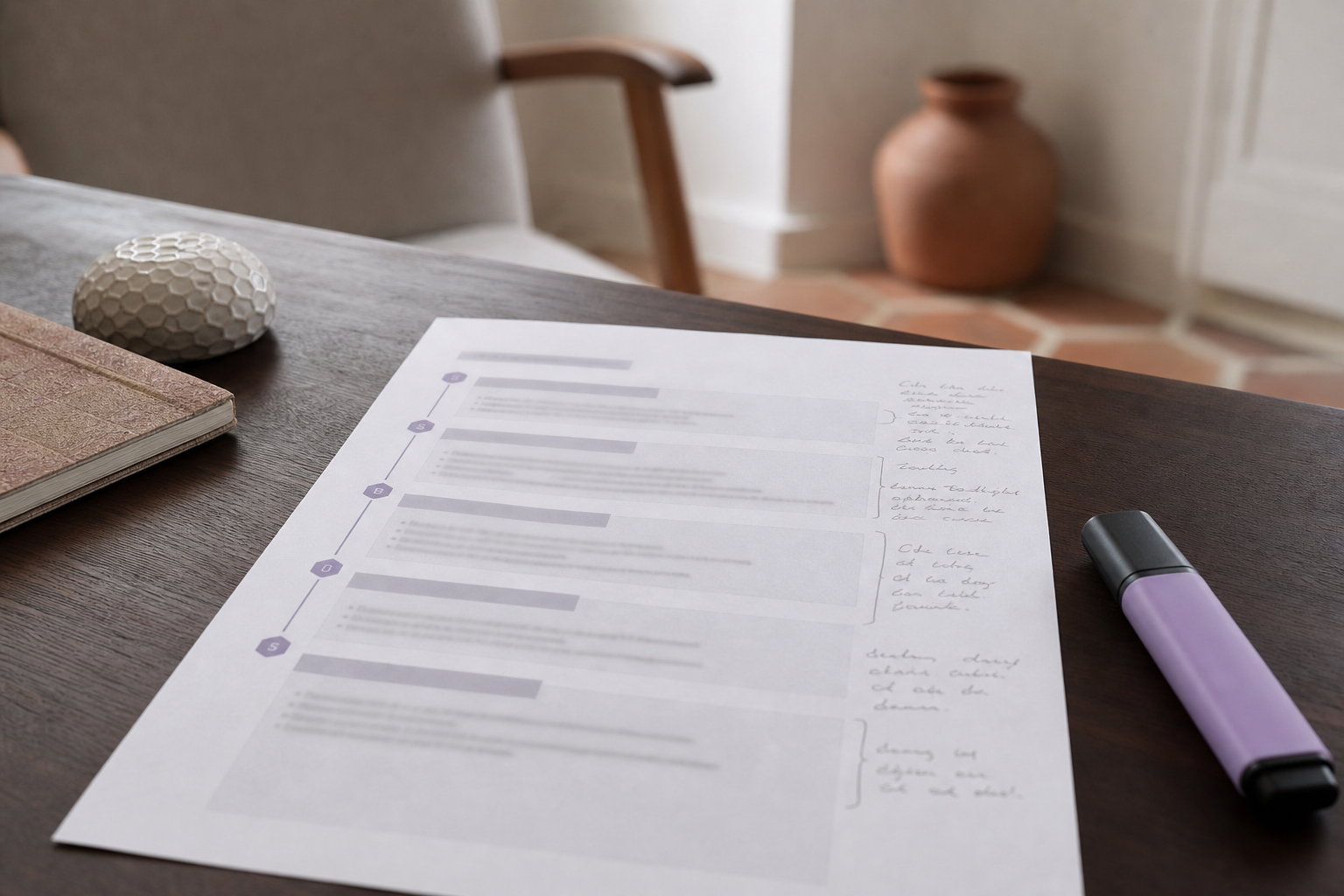
All of this rests on a single sheet of paper. The plan for an exposure therapy session fits on one side with six headings, and it holds one advantage over memory: it can be reread at the following appointment, which lets the clinician set what was planned against what occurred.
Step 1: reread the functional assessment and the topographical analysis
Preparing an exposure therapy session begins by rereading what is already known. The functional assessment describes the whole sequence: what precedes the fear, what the patient does when it arrives, and what that behaviour achieves. The third term is the one that matters today, because subtle avoidance is what ruins a well-designed trial. The assessment is not repeated at every appointment, but it is consulted before every trial.
The topographical analysis adds the shape of the response: where it is felt, how long it lasts, how often it appears and at what intensity. A fear of dogs may rest on the bark, on sudden movement, or on the touch of a muzzle. Those are three different trials, and only one of them tests the belief this patient actually holds.
Before the trial is designed, four elements are worth having located.
- Covert avoidance. Looking sideways, clenching the jaw, talking without pause, counting backwards.
- Safety signals. The companion in the waiting room, the anxiolytic in the pocket, the phone held in the hand.
- Conditions that amplify the response. Short sleep, caffeine, a recent conflict, a heavy workload.
- The learning history. The originating episode, where there is one, and what the surrounding environment made of it.
This step is not paperwork. The NICE guideline CG113 places exposure as a component of a cognitive behavioural treatment plan, not as a loose technique applied on its own account. A trial disconnected from the formulation produces arousal without change. The instruments used to track clinical progress supply the baseline against which the comparison will later be drawn.
Step 2: turn the trial into an explicit prediction
Here sits the decision that separates a prepared exposure therapy session from an improvised one. The inhibitory-learning framework set out by Craske and colleagues in 2014, and revised in 2022 towards inhibitory retrieval, holds that extinction does not erase the original fear association: it builds a competing association that then has to be retrieved. What is therapeutic is not that the patient endures, but that the patient discovers the prediction failing to come true.
Hence the variable actually being designed is expectancy violation, the discrepancy between what the patient anticipates and what takes place. A trial with no prior prediction cannot violate anything. So the explicit prediction is recorded in advance, in the patient's own words and in two parts: what the patient believes will happen, and how much confidence the patient places in it happening.
The earlier model, the emotional processing account of Foa and Kozak from 1986, explained change through within-session habituation. Habituation remains an observable phenomenon, and the clinician watches it fall most afternoons. What later research has qualified is its prognostic value: the drop in distress inside the session predicts medium-term outcome poorly. Measuring distress has an article of its own; here it is enough not to treat it as the criterion of success.
The design of the trial follows from the prediction, never the other way round. If the patient anticipates that the dog will lunge the moment they stand up, the trial consists of standing up. If the patient anticipates fainting at the sight of the needle, the trial has to reach the needle. The logic of stepwise progression orders the sequence, but it does not stand in for the question of which belief is on the table today.
It pays to write the prediction as one testable sentence. "I will get nervous" will not serve. "I will fall", "I will scream" or "I will faint inside a minute" will serve, because the trial can refute them in front of the patient who made them.
Step 3: session materials and preparing the room
The materials for an exposure therapy session are checked beforehand, not hunted for during. A trial interrupted because the record sheet is missing, because the stopwatch will not start, or because the room next door has visitors, loses exactly the moment at which the prediction was about to be shown up.
The working surface for an exposure therapy session fits on a short list.
- The plan sheet. Prediction, planned trial, variables to be recorded and decision rules.
- The record. Columns for the time, the situation, the distress reported and the behaviour observed.
- The stimulus. The object, the photograph, the recording or the environment, loaded and tested.
- The clock. A stopwatch visible to the clinician and not to the patient.
- Water and tissues. Courtesy rather than a safety signal: offered at the close, never in the middle of a trial.
Preparing the room settles three matters: interruptions, noise and exits. The phone stays outside, the sign goes on the door, and the diary is left with slack behind it, because a trial is not cut short by the clock of the next appointment. Craske and colleagues insist on the removal of safety signals, and the room is where a good many of them live.
What gets documented, and how, is the last thing to settle. The clinical record of the session is laid out with the same boxes as the recording sheet, so that transcribing it afterwards becomes mechanical. Anyone improvising the note at the end of the day loses half the data.
Step 4: a script for the therapist's own behaviour
The least-watched variable in an exposure therapy session is the behaviour of the therapist. Therapist accommodation consists of softening the trial so the patient suffers less: shortening the time, over-explaining, distracting with conversation, giving away the ending. It nearly always comes from good intentions and nearly always subtracts value from the trial.
Reassurance is its commonest verbal form. The patient asks whether something is going to happen and the clinician answers that it is not. The answer soothes in the moment and spoils the trial, because the certainty now comes from the therapist instead of from experience. That answer is settled in advance, in writing, and it usually looks something like this: "I don't know, and that is exactly what we are going to find out."
Counter-programming is the other temptation. Bringing relaxation or paced breathing into the middle of a trial switches off the arousal without refuting the belief. Wolpe paired the hierarchy with relaxation in 1958 on the principle of reciprocal inhibition, and that inheritance is still alive in a great many consulting rooms. Contemporary exposure, by contrast, leaves the arousal where it stands: it is the signal that something is still there to be learned.
What does belong in the script, among the strategies Craske lists, is affect labelling: asking the patient to name what is being felt rather than steering attention away from it. Naming is not reassuring. It is also worth deciding in advance how much of one's own silence to hold, that is, how many seconds the clinician can sit through without filling the gap with an explanation.
A short script is enough. Three prepared sentences for the three predictable questions, and one firm decision about what the therapist will not do even when asked to.

What mistakes should be avoided during exposure therapy?
Almost every failure is committed while preparing an exposure therapy session, even though it shows itself inside the room. The exposure therapy mistakes that surface most often when cases are reviewed with colleagues are these [CITATION TO VERIFY].
- Mis-grading the challenge. The rung chosen is so low that no prediction is left to refute, or so high that the patient withdraws. Both extremes yield sterile sessions.
- A trial with no prediction. The patient is taken into the situation with nothing written down about what was expected to happen. No contrast is possible.
- Reassurance. The clinician meets the doubt with a certainty of their own and moves the learning somewhere else.
- Counter-programming. Relaxation, distraction or kindly conversation arrives at the moment of highest arousal.
- Closing on relief. Ending the trial as the distress falls rewards withdrawal and leaves the belief untouched.
- Improvised materials. Hunting for the record sheet or loading the stimulus with the patient watching turns the preparatory work into a performance.
There is a seventh mistake, subtler than the rest, which consists of taking the fall in distress for the outcome itself. A trial in which the patient ends up tense, yet has established that the prediction did not hold, is worth more than a comfortable one with no surprises. This is the point at which the inhibitory-learning model changes how an exposure therapy session is read.
Nearly all of these failures share one root: the clinician's own discomfort. They are best examined in case reviews with experienced psychologists, which is where the accommodations nobody spots in themselves get named. The frame for that supervision has criteria of its own and is not developed here.
Step 5: decision rules, in writing, before the door opens
The last piece in preparing an exposure therapy session is the most thankless: deciding in advance what will be done with whatever happens. Three written rules spare three internal arguments conducted in the heat of the moment.
- The progression rule. Which result moves the patient up a rung at the next appointment, and which result repeats the same one.
- The repetition rule. How many trials at the same rung are run before the belief is taken to have given way.
- The contingency rule. Which alternative trial is run if the materials fail or the patient arrives after an overwhelming week.
Writing these rules beforehand protects against the decision taken while the room is still warm, which is almost always the more conservative one. The criteria for stopping a trial are agreed as part of the treatment frame and reviewed separately; here it is only a matter of checking that they exist on paper and that the patient knows them.
The review by Maples-Keller and colleagues (2017) describes how far technology has widened the repertoire of stimuli available in the consulting room, and with it the precision at which a trial can be calibrated. When the stimulus is computer-generated, the preparatory work gains reproducibility: the same environment, the same distance and the same sequence, appointment after appointment. Anyone who wants to see how a trial is configured inside a clinical system can book a demonstration with the clinical team and walk the process through on a case of their own.
This article is for informational purposes for psychology professionals. It is not clinical advice for any individual case and does not replace the judgment of the licensed psychologist in charge. VRET is professional clinical-support software, not a CE-marked medical device.
Frequently asked questions
How much preparation does an exposure therapy session take?
Preparing an exposure therapy session runs to fifteen or twenty minutes for a case already under way, and rises to thirty or forty for the first trial with a new patient. The difference lies in rereading the functional assessment, which the first time has to be done in full. From the third or fourth appointment the preparatory work drops to ten minutes, because the previous plan sheet already carries half the decision. That time is not optional: every minute saved beforehand reappears inside the room as improvisation. It is worth blocking it out in the diary the way the session itself is blocked out, protected and free of calls.
What goes on the plan sheet before the patient walks in?
Six headings are enough to plan an exposure therapy session: the rung chosen from the hierarchy, the patient's prediction in its literal wording, the trial as planned with its minimum duration, the variables that will be recorded, the behaviour the therapist rules out in advance, and the progression rule for the next appointment. The sheet is written by hand and fits on one side. Its purpose is not bureaucratic but to leave in writing what will later be set against what happened. A written plan also protects against retrospective reconstruction, that tendency to remember a trial as having gone the way it was planned when it did not.
How is the prediction that the trial will test actually formulated?
With two questions put to the patient, either at the previous appointment or in the opening minutes of the current one: what does the patient believe is going to happen, and how much confidence is placed in it happening. The answer is recorded verbatim, without translation into technical language. Any formulation testable within the span of the trial will serve: falling, screaming, losing control, fainting, being unable to breathe. Vague formulations of the "I will get very nervous" kind will not, because nervousness duly arrives and confirms the prediction while teaching nothing. Once the belief stands written as an observable event, the trial can refute it and the patient notices.
How is the session prepared when the patient arrives after an overwhelming week?
The contingency rule is written in advance precisely for this. Conditions that amplify the response, such as short sleep, a recent conflict or a heavy workload, do not force the trial to be cancelled, but they do call for the chosen rung to be reviewed and the context to be recorded on the sheet. Repeating the previous rung under those conditions yields information about the variability of the learning, which is one of the strategies Craske's framework recommends exploiting. What is not appropriate is to swap the trial for a conversation about the week, unless the formulation of the case indicates otherwise.
What changes in the preparation when the trial is run in virtual reality?
Preparing an exposure therapy session in virtual reality changes the materials and the pre-session checks, not the clinical logic. The clinician still rereads the functional assessment, still writes down the prediction and still decides on a personal script. Verification tasks are added: environment loaded, trial parameters set, headset charged and floor space clear. What is gained is reproducibility, because the parameters are stored and the next appointment repeats the exact configuration. The preparatory work also shortens with use, since the system keeps earlier configurations on file. Published plans start at $119 a month for the independent practitioner, $289 for a clinic and $1,499 for a group practice, with a 30-day money-back window. Anyone weighing it up usually wants a full demonstration first, with a real case on the table.
Keep reading
Exposure Therapy Session: What Happens, Phase by Phase
What happens in an exposure therapy session, phase by phase: framing, approach, within-session recording and closure, and when an exposure is stopped.
Clinical protocolsExposure Hierarchy: What It Is and How to Build One
What an exposure hierarchy is and how to build one step by step: item selection, anticipated ratings, number of levels, and the design errors to avoid.
Clinical protocolsWhat is interoceptive exposure? Panic and body sensations
What interoceptive exposure is: how the feared body sensations of panic disorder are induced, which exercises the repertoire holds and what precautions apply.
VRET is professional clinical-support software, not a CE-marked medical device. Clinical supervision remains with the licensed psychologist in charge.