VR Headset Hygiene Protocol: What No One Tells You
By Equipo clínico VRET
Between patients, a VR headset needs a reproducible hygiene protocol: 70% isopropyl alcohol on the casing and durable foam, a dry microfiber cloth for the lenses (never alcohol), a replaceable or disposable hygienic cover, specific management for long hair and glasses, and an airing time of 5 to 10 minutes. Without a protocol, skin incidents and poor clinical adherence follow.
Why Headset Hygiene Is Not a Detail — It's Part of the Clinical Frame
A VR headset reused between patients comes into direct contact with the forehead, temples, nasal bridge, scalp, and, on occasion, tears or nasal secretions due to proximity. It is a device involving prolonged skin contact.
In clinical practice, the absence of a hygiene protocol visible to the patient reduces treatment adherence. Patients with a fear of contamination, those coming from a hospital setting, and, more generally, patients with sensory sensitivity or OCD, examine the headset closely before putting it on. If they perceive it as dirty, their SUDS rises before the exposure even begins.
Beyond the clinical aspect, material wear is real: the facial foam absorbs sweat, the strap anchors accumulate hair grease, and the lenses get smudged with eyelashes and makeup. Without maintenance, a professional headset loses image quality within six months.
Materials for a Basic Hygiene Kit
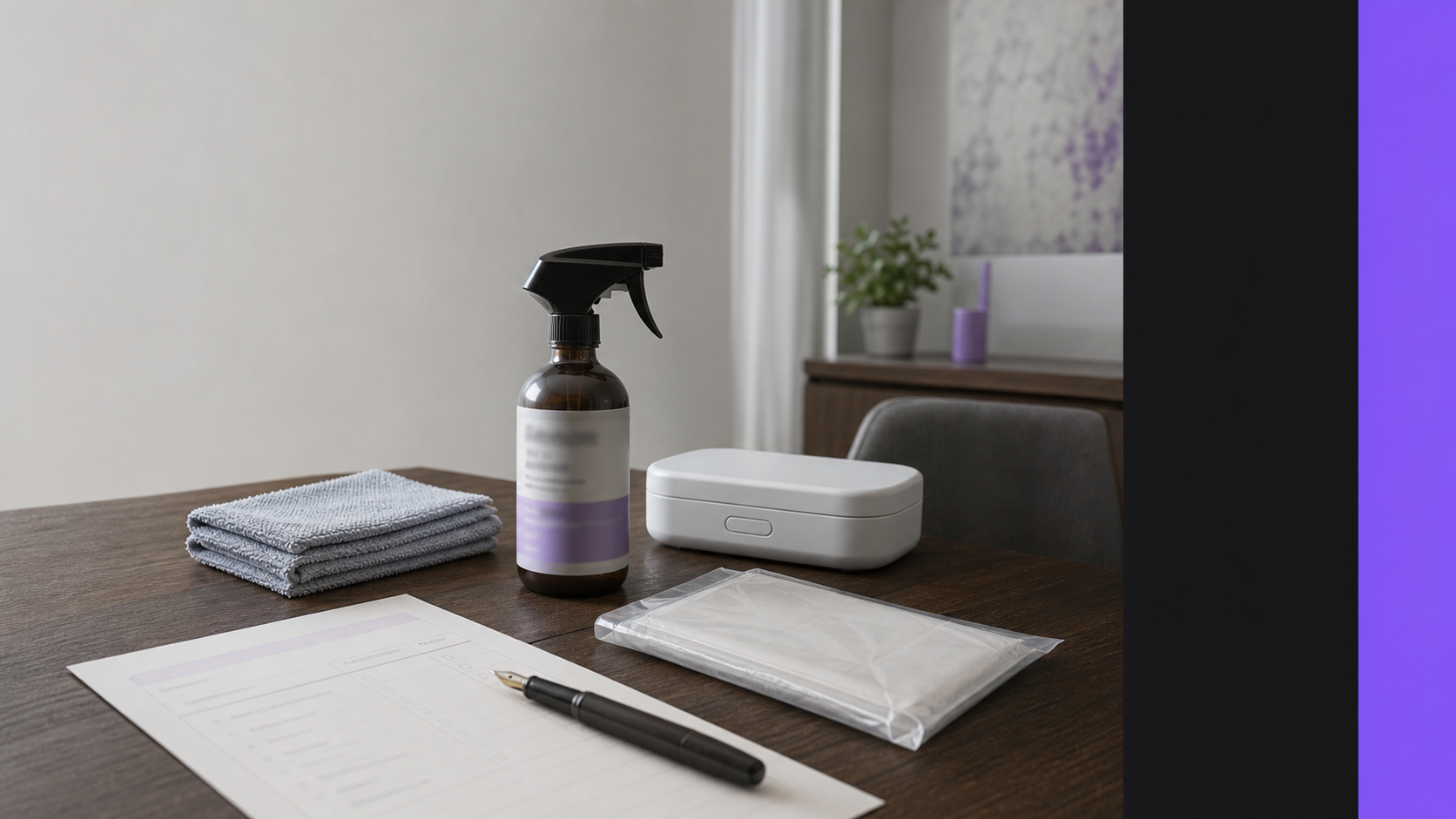
A reasonable kit fits in a clear plastic box on the practice desk, visible to the patient. These are the minimum components.
1. 70% isopropyl alcohol in a dispenser bottle or individual wipes. This is the standard disinfectant agent for the plastic casing, controllers, and plastic straps. Never apply it to the lenses or to the original facial foam without a cover. commercial commercial
2. Clean microfiber cloths, at least two different colors (one for lenses, one for the casing). The lens cloth should be washed at 40°C, without fabric softener, separately from the rest.
3. Replaceable hygienic covers. For Meta Quest, compatible products such as VR-Cover are available in washable silicone or synthetic foam with a washable cover. Pico offers its own official hygiene kit (Pico Hygiene Kit) with a replaceable facial interface. Official replacement parts exist for PSVR2.
4. Disposable covers. Useful for patients with reactive skin, silicone sensitivity, or conditions that increase sweating (panic attacks, claustrophobia). These are non-woven covers discarded after the session.
5. Dry cotton swabs, for cleaning dust from around the lenses without rubbing.
6. A manual air blower (bulb) to remove particles from the lenses without contact.
Materials specifically not recommended: kitchen cloths, toilet paper (sheds fibers), scented or oil-based wipes (smudge lenses), undiluted 96% alcohol (can damage plastics), hydrogen peroxide (corrodes metal straps). For a broader practice-setup reference, see the VR practice checklist.
Step-by-Step Protocol Between Patients (5 to 8 Minutes)
The protocol should be short, reproducible, and, whenever possible, executable while the departing patient completes their invoice or their between-session tasks. The recommended sequence is as follows.
1. Remove the reusable hygienic cover if one was used, and set it aside for later cleaning. If a disposable cover was used, remove and discard it.
2. Quick visual inspection: are there visible traces of makeup, sweat, or hair? If so, spot-clean before general disinfection.
3. Disinfect the casing, strap, anchors, and controllers with a microfiber cloth lightly dampened with 70% isopropyl alcohol. Work zone by zone: frontal area, temporal area, occipital area, controllers.
4. Never use alcohol on the lenses. First use the air blower to remove dust, then wipe with the dry microfiber cloth in a circular motion from center to edge. If a persistent mark remains, use a cloth dampened only with distilled water, then dry immediately.
5. Put on the clean hygienic cover for the next patient. Each recurring patient can have their own labeled cover, which is especially useful in practices seeing three or four VR patients per day.
6. Leave the headset with the strap open, in an upright position, for 5 to 10 minutes of airing. This allows the alcohol to fully evaporate and the foam to dry if there was heavy sweating.
7. Note any incident on the daily log sheet: persistent makeup marks, a patient with elevated sweating, or a complaint about odor or texture. This information informs the cover replacement schedule.
Managing Long Hair and Hairstyles
Long hair is the number one source of mechanical discomfort in VR sessions lasting more than 20 minutes. It should be addressed as part of the session framing, not improvised.
Before putting on the headset, ask the patient to remove hair clips, wide headbands, or Bluetooth headphones with a rigid arch. These objects rub against the strap and can leave marks or shift the headset during the exposure.
For high ponytails, suggest the patient lower them to the nape of the neck before the session, or switch to a low ponytail or low bun. The strap on most headsets crosses the occipital area and collides with any high hairstyle.
If the patient has braids, locs, or an elaborate hairstyle, adjust the strap at the front and temples, leaving the back looser. Some headsets, such as the Meta Quest 3 with the Elite Strap, distribute pressure better and are more comfortable in these cases.
After a session involving long hair, run the air blower or a clean brush over the anchors to remove hair before disinfection. Hair trapped in the anchors is the leading cause of mechanical strap failure.
Patients With Glasses and Contact Lenses
Approximately one in three adult patients arrives at the practice wearing glasses or contact lenses. Proper management prevents scratches on the headset lenses and a poor image experience.
Small or medium glasses (frame narrower than 142 mm). Many headsets accommodate glasses underneath with an official spacer. The Meta Quest 3 includes one in the box; the Pico 4 Enterprise has its own system. It is essential to fit the spacer before putting on the headset, because without it the patient's lenses can scratch the headset's lenses.
Large glasses. If the frame exceeds the headset's interior space, consider two alternatives: custom prescription lens inserts that clip into the headset (several European suppliers manufacture these by prescription), or a session with contact lenses if the patient tolerates them and has a prescription.
Contact lenses. Generally compatible without additional adjustments. It is worth asking about the patient's lens-wear duration; long VR sessions can increase eye dryness, especially in scenarios with a low blink rate.
Deep Maintenance Frequency and Parts Replacement
Beyond the between-patient protocol, it is worth scheduling deep maintenance tasks on the practice calendar. These are the recommended frequencies for a practice with regular clinical use.
Weekly. Hand-wash reusable hygienic covers with neutral soap and warm water, and let them air-dry completely before reuse. Clean the controllers with an alcohol-dampened cloth, including the trigger area and buttons.
Monthly. Inspect the strap: are there cracks, looseness, or loose screws? Clean the interior of the headset with the air blower and a dry cotton swab, especially around the sensors. Replace the lens microfiber cloth if it shows fraying.
Every three months. Replace the main reusable hygienic cover. Synthetic foam and silicone lose absorption capacity and elasticity over time. This is the part that wears out fastest.
Every six months. Lens calibration and a dead-pixel check. Cable inspection if the headset is wired (PSVR2). Inventory and restocking of disposable covers.
These intervals can be shortened if the practice exceeds 25 VR sessions per week or if visible signs of wear appear.
When to Take the Headset Out of Service
There are three situations that require taking the headset out of the clinical schedule until resolved.
1. Visible lens damage (a deep scratch, a persistent stain that does not come off with distilled water). This compromises immersion quality and, in exposure scenarios, can be a factor that artificially raises SUDS due to visual discomfort.
2. Facial foam or silicone that is deteriorated or cracked. This is an area of direct skin contact and cannot be reliably disinfected. Replace immediately.
3. Any suspected exposure to bodily fluids during a session (vomiting from intense cybersickness, spontaneous nosebleed, heavy tearing in a patient with PTSD). In these cases, the protocol is to remove the cover, discard disposable ones, disinfect the casing with 70% alcohol, leave the facial area untouched for at least 24 hours, and replace all of the patient's reusable covers.
Document the incident on the daily log sheet and, if it affects an identifiable patient, also in their clinical record as a session event.
This article is for informational purposes for psychology professionals. It is not clinical advice for any individual case and does not replace the judgment of the licensed psychologist in charge. VRET is professional clinical-support software, not a CE-marked medical device.
Frequently asked questions
Can I use pharmacy disinfectant wipes like Sanytol on the headset?
Only on the casing and the strap, and only if they are labeled for plastic surfaces and free of oils or fragrances. Check the composition: wipes containing quaternary ammonium compounds or essential oils leave residue on plastics. Never disinfect the lenses with that type of wipe; always use a dry microfiber cloth or, at most, distilled water.
Is it safe to reuse the same hygienic cover with multiple patients throughout the day?
A silicone cover that can be cleaned with 70% alcohol can be used with several patients in one day if it is properly disinfected between each one and shows no cracks. A synthetic foam cover with a washable covering should not be reused the same day without an intermediate wash. When patients have reactive skin, it is better to switch to disposable covers that day.
What should I do if a patient feels dizzy and sweats heavily during exposure?
After the session, remove the cover and discard it if disposable. If reusable, wash it immediately. Disinfect the casing with 70% alcohol, focusing on the temporal and frontal areas. Leave the headset airing with the strap open for at least 15 minutes before the next patient. If the issue recurs with the same patient, review the exposure hierarchy and acclimation time.
Does 70% isopropyl alcohol damage the headset's elastic straps with continued use?
Applied sparingly with a dampened (not soaked) cloth and followed by drying, it causes no significant deterioration over periods of 12 to 18 months of intensive use. Damage occurs when alcohol is sprayed directly onto the elastic fabric or when the strap is submerged. The operating rule: a dampened cloth, never a direct spray.
Do I need a certificate or hygiene protocol sheet for a health inspection or GDPR audit?
Regional health inspections do not require a specific protocol for headsets in private clinical psychology practices, but it is worth keeping a one-page hygiene protocol filed alongside the practice's other protocols (waste management, general cleaning, first aid). For GDPR (data protection) documentation, what matters is not the hygiene itself but the traceability of the data generated by VR sessions.
Can I use the same protocol for the Meta Quest 3, Pico 4 Enterprise, and PSVR2?
The general protocol (70% alcohol on the casing and strap, dry microfiber on the lenses, a replaceable hygienic cover, and subsequent airing) is common to all three. Covers and replacement parts are manufacturer-specific: VR-Cover and similar products for Meta Quest, the official Pico kit for the Pico 4 Enterprise, and official Sony replacement parts for PSVR2. Do not swap covers between models: facial geometry differs and pressure is distributed differently.
Keep reading
Your First VRET Session: A Step-by-Step Clinical Protocol
A structured protocol for the first VRET session: pre-session assessment, headset acclimatization, low-intensity exposure, SUDS and session closure.
Practice managementVRET Contraindications: When Not to Use It With a Patient
Absolute and relative contraindications for VRET: epilepsy, psychosis, dissociation, pregnancy, BPPV and cognitive impairment, plus the screening list.
Practice managementHow to Explain VR Exposure Therapy to a Skeptical Patient
A clinical communication script for introducing VRET to skeptical patients — what to say, what to avoid, and how to handle the video game objection.
VRET is professional clinical-support software, not a CE-marked medical device. Clinical supervision remains with the licensed psychologist in charge.