Fear of Flying (Aviophobia): A VR Exposure Therapy Protocol
By Equipo clínico VRET
Fear of flying affects a considerable share of the adult population, and in-vivo exposure is logistically unworkable for most practices. Virtual reality can faithfully reproduce the stimuli of air travel — check-in, boarding, takeoff, turbulence — and deliver them in a graded, controlled way. Available evidence, from Rothbaum (2000) to Carl et al. (2019), indicates that VRET shows consistent results comparable to in-vivo exposure. This article describes the typical 6-to-10 session protocol a licensed psychologist can integrate into practice.

Why Aviophobia Is an Ideal Clinical Case for VR Exposure
Fear of flying, classified in the DSM-5-TR as a situational-type specific phobia, has an estimated prevalence of roughly a quarter of the adult population when subclinical presentations are included, with 2 to 6 percent meeting full diagnostic criteria. The functional impact is significant: lost job opportunities that require travel, family isolation, abandoned life plans, and frequent misuse of self-prescribed anxiolytics.
The usual clinical challenge is the practical impossibility of exposing the patient to a real aircraft with the frequency and gradualness that a behavioral protocol requires. Imaginal exposure, even when well conducted, depends on the patient's capacity for visualization and their tolerance for the dissonance between the mental representation and the physiological response. Virtual reality resolves precisely that sensory gap.
From an operational standpoint, a VR headset reproduces the airport, the cabin, and the dynamics of flight with a level of fidelity sufficient to activate the phobic response without requiring any travel. The psychologist controls the stimulus intensity at every moment and can pause, rewind, or adjust variables such as turbulence, sound, or visibility.
Neurobiology of Anticipatory Panic
The phobic response to flight-related stimuli results from a threat-processing circuit in which the amygdala labels the signal as dangerous before the medial prefrontal cortex can even intervene. In aviophobia, this bias is typically consolidated through associative learning, generalization, or vicarious transmission.
The hippocampus contextualizes the stimuli: a narrow seat, a particular smell, a slight vibration can recall previous episodes. The ventromedial prefrontal cortex, responsible for top-down regulation, tends to be inhibited during phobic activation, which explains the sense of lost control patients describe.
Repeated exposure without aversive consequences favors habituation and, above all, the inhibitory learning proposed by Craske and colleagues: the original learning is not erased, but a competing memory is built that activates earlier in the presence of the stimulus. VR facilitates this process because it allows multiple trials across varied contexts within a single session, something impossible on a real flight.
Accumulated Clinical Evidence
The randomized controlled trial by Rothbaum and colleagues, published in 2000, was the first to demonstrate the differential efficacy of VR exposure over waitlist control in aviophobia, with the effect maintained at six months. Da Costa, Sardinha, and Nardi later replicated the findings in a Brazilian sample using a shorter protocol.
The meta-analysis by Powers and Emmelkamp (2008) and the 2019 update by Carl and colleagues position VR exposure as non-inferior to in-vivo exposure in specific phobias, with large effect sizes versus control. For aviophobia specifically, protocol completion rates are higher than those reported for in-vivo exposure, suggesting that the VR modality improves adherence.
These figures deserve some caveats: most studies have limited sample sizes, and protocols vary in number of sessions and in the degree of subsequent real-world behavioral exposure (the actual flight). Even so, current clinical consensus recognizes VRET as a first-line option when in-vivo exposure is not feasible.
Pre-Treatment Assessment and Inclusion Criteria
Before proposing a VR exposure protocol, a standard assessment should be completed, including a structured clinical interview, a specific scale such as the Fear of Flying Scale (FFS) or the Flight Anxiety Situations Questionnaire (FAS), and a baseline SUDS reading during imaginal exposure.
Common exclusion criteria include comorbid unstabilized panic disorder, vertigo or VR motion sensitivity that does not resolve after two adaptation sessions, advanced pregnancy, a history of photosensitive epileptic seizures, and acute psychotic disorders. PTSD related to an actual aviation incident calls for a different protocol, not simple aviophobia treatment.
It is recommended to devote the first session to psychoeducation: explaining the maintenance model, introducing the headset, showing the scenario, and building the patient's personalized stimulus hierarchy together. It also helps to agree on a verbal or gestural signal for immediate withdrawal, a diaphragmatic breathing routine, and an explicit commitment to avoid benzodiazepine use during exposure sessions.
One screening step is worth never skipping, because it changes the plan entirely: ask explicitly about claustrophobia. A proportion of patients presenting with fear of flying do not fear the flight itself but being shut in a space they cannot leave for hours.
The question that separates them is simple: what would happen if the aircraft were stationary on the ground, doors closed, with no prospect of taking off? If anxiety stays high, confinement weighs as much as or more than the flight, and the hierarchy has to grade the enclosed space alongside the flight phases. If it drops, it is aviophobia and the usual sequence applies.
It is also worth separating aviophobia from panic disorder. Where the patient fears their own bodily sensations rather than the aircraft, situational exposure falls short and interoceptive work is needed. A practical indicator: if the patient has had equivalent episodes on a train, in a lift or on the underground, the axis is not flying.
Typical Stimulus Hierarchy in Practice
The hierarchy is built together with the patient and typically follows an ascending sequence. First, arrival at the airport, baggage check-in, and passing through security: contextual stimuli with no flight elements, ideal for the first trials. Second, the boarding gate and sighting aircraft through the terminal windows, where the first anticipatory reactions appear.
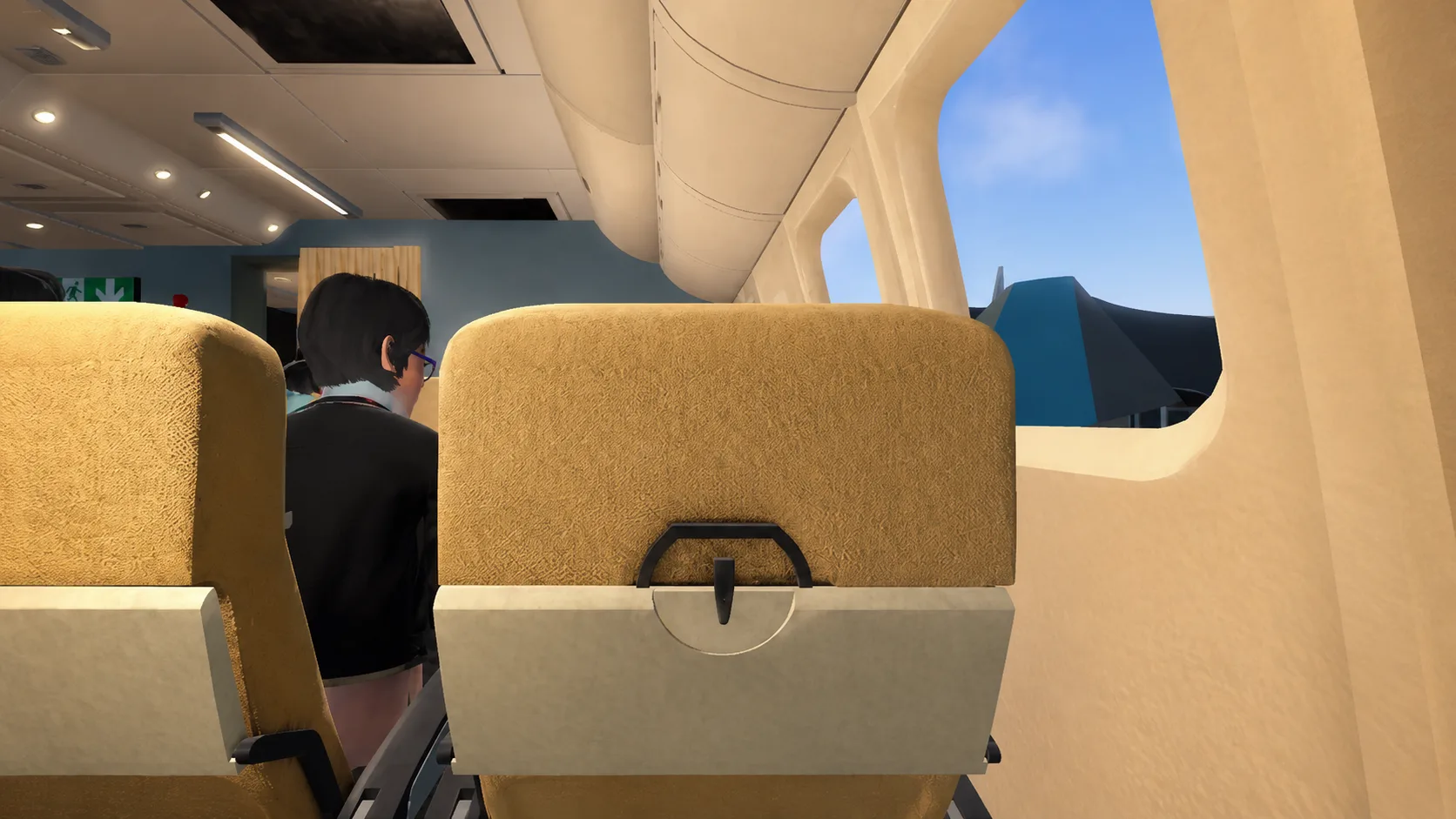
Third, boarding the cabin, finding the seat, and door closure. Fourth, the taxiing sequence and takeoff roll, with its sound and vibration cues. Fifth, stable cruising flight, a phase many patients approach with the greatest negative anticipation. Sixth, turbulence graduated in intensity. Seventh, descent and landing.
Each step is worked through until the reported SUDS activation drops below an agreed threshold, typically 30 out of 100, and the patient can sustain it for at least five minutes without cognitive avoidance strategies. Only then does the protocol move to the next level.
Recommended Protocol Structure Across 6-10 Sessions
A typical operational sequence includes one assessment-and-psychoeducation session, one session for headset habituation and testing the neutral scenario, four to six sessions of progressive exposure through the hierarchy levels, one consolidation session with turbulence and randomized variations, and a final relapse-prevention session with a real-flight plan.
Each exposure session runs between 45 and 60 effective minutes, with an initial SUDS calibration segment, a central immersion segment, and a closing segment in which the patient verbalizes their progress and records what was learned. Sessions are usually spaced weekly, although some patients respond better to an intensive format of two sessions per week over a month.
The psychologist records, in each session, peak SUDS, the latency to habituation, the most frequent intrusive cognitions, and the regulatory strategies used. This information feeds the hierarchy and guides the titration of the next session.
Session Closure, Transfer, and the Real Flight
Transfer to a real flight is the ultimate criterion of clinical success. After completing the VR hierarchy, it helps to propose a staged plan: a visit to the airport without boarding, a short accompanied domestic flight, an unaccompanied domestic flight, and finally an international flight or a flight with anticipated turbulence.
Relapse prevention includes a personal script with coping cognitions, a brief VR re-exposure routine before the real flight, and, for patients with comorbid anxiety, a booster session at three months. Available evidence on effect maintenance at 12 months supports this approach.
It is advisable to explicitly discourage occasional benzodiazepine use during real flights: they block the inhibitory learning that exposure has just built and increase the likelihood of relapse. If the patient requests them, it helps to reframe the role of medication within the therapeutic process.
Cognitive Work During Exposure
The most frequent cognitions in aviophobia include 'the plane is going to crash,' 'I won't be able to escape if I feel bad,' 'I'm going to lose control and make a scene,' 'my body won't withstand the pressurization,' and 'something bad is going to happen and I won't be able to do anything.' Each one is addressed through prior identification, exposure during the session, and recording the observed outcome after the immersion.
In each session, the psychologist collects the patient's predictions about peak SUDS, the estimated duration of activation, the expected physical sensations, and the final subjective rating. Comparing these predictions with subsequent observation is one of the most powerful cognitive components of the protocol and consolidates a competing memory against the original belief.
It also helps to identify and discuss beliefs about anxiety itself ('anxiety proves something is wrong,' 'if I don't control it, it will become unbearable'). Reframing these metacognitions reduces the interpretive spiral and improves tolerance of activation during the real-flight phase, where the psychologist is no longer present in real time.
Integrating the Scenario into Practice
Integrating a VR aviophobia protocol into practice requires only a standalone headset, a stable internet connection, and an obstacle-free space of about two by two meters. The airport and cabin scenarios, along with graduated turbulence and ambient sound controls, let the psychologist administer intensity without leaving the office.
The VRET team has developed the aviation exposure module with an emphasis on gradualness: the VR headset allows adjustment of variables such as cabin noise, turbulence intensity, outside visibility, and crew narration. The psychologist always retains control from the dashboard panel and can pause the immersion with a single click.
The VRET team supports onboarding with downloadable protocol materials, a brief training session, and clinical support during the first three months. If you'd like to assess whether this scenario fits your practice, you can book a demo with the team.
This article is for informational purposes for psychology professionals. It is not clinical advice for any individual case and does not replace the judgment of the licensed psychologist in charge. VRET is professional clinical-support software, not a CE-marked medical device.
Frequently asked questions
How many sessions are needed to treat fear of flying with virtual reality?
The average reported in the literature ranges from six to ten 50-minute sessions. The exact duration depends on initial severity, the presence of comorbidities, and the patient's availability for subsequent in-vivo exposure.
Is VRET effective if the patient has never flown?
Clinical efficacy does not depend on prior flight history, but on the ability to activate the phobic response during exposure. For patients without flying experience, the protocol can be extended with psychoeducation sessions on flight mechanics and objective aviation safety data.
Can VR cause cybersickness in patients with fear of flying?
Cybersickness occurs in a minority of patients and usually resolves after two or three adaptation sessions. It helps to start with static scenarios before introducing takeoff and turbulence, and to plan frequent pauses during the first immersions.
Does VR exposure replace a real flight?
No. VR exposure is an intermediate step that prepares the patient for the real flight, which remains the ultimate transfer criterion. Evidence suggests better protocol adherence and lower dropout when both modalities are combined.
Can benzodiazepines improve the clinical outcome?
Evidence indicates that benzodiazepines administered right before exposure can interfere with inhibitory learning. Their use is generally discouraged during exposure sessions, and during the transfer flight as well, unless specifically indicated medically.
Is the cost covered by private health insurance?
Coverage depends on each insurer and how the treatment is categorized. It helps to present the protocol as a cognitive-behavioral intervention supported by clinical software, not as an experimental technique, and to request prior authorization where applicable.
How do I tell fear of flying from claustrophobia?
With one screening question at assessment: what would happen if the aircraft were stationary on the ground, doors closed, with no prospect of taking off? If anxiety stays high, confinement weighs as much as or more than the flight, and the hierarchy must grade the enclosed space alongside the flight phases. If it drops clearly, it is aviophobia and the usual check-in, take-off, cruise and landing sequence is sufficient.
Keep reading
Driving Phobia After a Crash: Specific Phobia or PTSD?
Driving phobia of traumatic origin: criteria that separate it from PTSD, what to treat first in mixed presentations, and how to build the driving hierarchy.
Specific phobiasClaustrophobia Exposure Hierarchy: Nine Graded Levels
A nine-level claustrophobia exposure hierarchy built on two independent axes, the differential against agoraphobia, and a brief protocol for MRI referrals.
Specific phobiasAcrophobia vs Vertigo: A Clinical Differential Guide
Acrophobia, vestibular vertigo and visual height intolerance get confused in practice. Five intake questions, two questionnaires and clear referral criteria.
VRET is professional clinical-support software, not a CE-marked medical device. Clinical supervision remains with the licensed psychologist in charge.