Amaxophobia: VR Exposure Therapy for Driving Phobia
By Equipo clínico VRET
Amaxophobia is a common phobia in private practice that often arrives late and undertreated. In vivo exposure raises serious logistical problems: a second driver, insurance, legal liability, and gradation. Virtual reality lets clinicians work with traffic, highways, intersections, rain, and night driving at adjustable intensity, without risk or dependence on a family member. This article covers the clinical picture, the available evidence, and the typical 8-to-12-session VR protocol.

An Underestimated Phobia in Clinical Practice
Amaxophobia, or driving phobia, shows up in private practice more often than its prevalence figures suggest. Epidemiological samples place it around 5-10 percent of adult drivers, with a slightly higher proportion of women and a mean age of onset between 25 and 45. The condition typically consolidates after a minor accident, a panic experience behind the wheel, or a prolonged period without driving.
The functional impact is significant: loss of autonomy, dependence on others, giving up job opportunities that require mobility, strain on family dynamics, and, not infrequently, permanent abandonment of driving altogether. In rural or peri-urban settings, this loss translates into isolation.
Yet amaxophobia tends to reach the consulting room late. Many patients accumulate years of avoidance before seeking help, have tried conventional driving schools without success, or have been referred for symptomatic pharmacological treatment. By the time they finally consult a psychologist, the avoidance network is well established and perceived self-efficacy behind the wheel is close to zero.
Why In Vivo Exposure Is Logistically Complex
The gold-standard approach for specific phobias, progressive in vivo exposure, runs into practical obstacles in amaxophobia. First, insurance coverage: the psychologist is not typically listed as an authorized additional driver, and civil liability for an incident during a session would be hard to defend.
Second, the availability of a second driver or co-therapist. Even when the patient drives with a family member, the relational dynamic contaminates the exposure: the family member tends to either overprotect or pressure, and rarely holds to the graduated hierarchy that inhibitory learning requires.
Third, real gradation. An in vivo session cannot reproduce rush-hour traffic, a highway merge in the rain, or a left turn at a five-lane intersection on demand. The therapist is at the mercy of actual traffic and weather, which stretches the protocol out over months and undermines adherence.
What VR Simulation Adds to the Behavioral Protocol
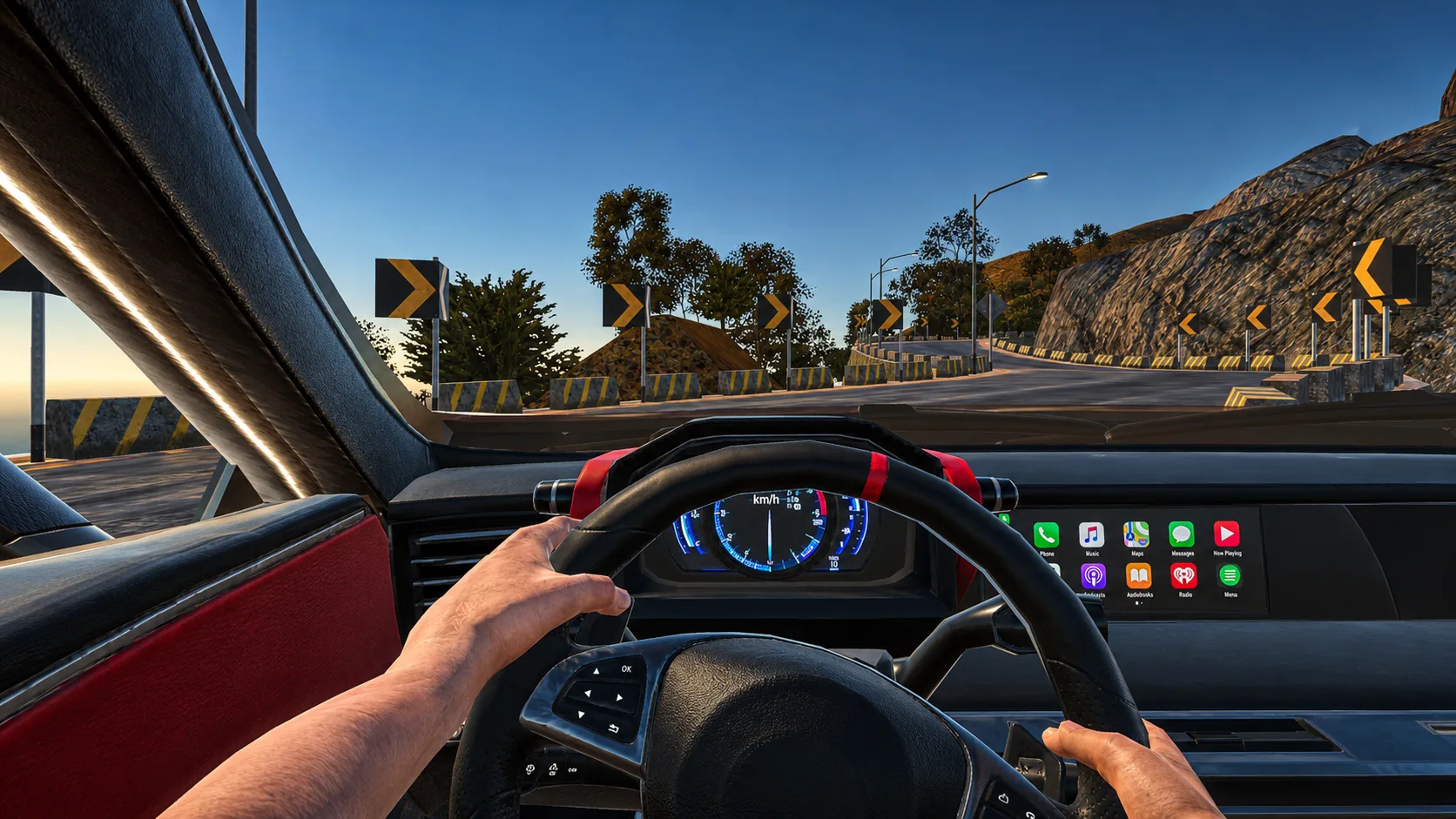
VR exposure resolves much of this. The psychologist has, right in the office, a reproducible and adjustable driving environment. Road type (urban, secondary, expressway, highway), traffic density, weather (sun, rain, fog, snow), time of day (daytime, dusk, night), and intersection geometry can all be adjusted.
The session takes place seated in the office, with no real physical risk, which lowers the threshold for starting exposure and makes it possible to work with patients whose avoidance is very severe, including those who won't even sit in the driver's seat of a parked car.
Objective tracking of physiological variables alongside subjective SUDS ratings makes it easier to calibrate the next session. The psychologist can repeat the same segment as many times as needed, introduce controlled variations to avoid context dependency, and consolidate inhibitory learning over a much shorter period than the equivalent in vivo exposure.
Available Evidence
The specific empirical base for VRET in amaxophobia is smaller than for flight or height phobias, but it's growing. Wald and Taylor published an initial small-sample study in 2003 in which VR exposure significantly reduced anticipatory anxiety and improved patients' ability to resume driving. Walshe and colleagues described a combined VR and in vivo exposure protocol in 2003 with good results in patients with a prior accident.
Beyond the specific studies, the broader meta-analyses by Carl and colleagues (2019) and Powers and Emmelkamp (2008) support the equivalence of VRET and in vivo exposure for specific phobias. Extrapolating to amaxophobia is reasonable as long as the protocol is paired with in vivo transfer exposure.
The evidence should be framed with appropriate caution: the heterogeneity of stimuli (urban, highway, rain) and the limited standardization of protocols mean that phobia-specific meta-analyses are still scarce. Even so, VR is a defensible first-line option when in vivo exposure is not feasible.
Initial Assessment and Inclusion Criteria
The initial assessment includes a structured clinical interview, specific scales such as the Driving Cognitions Questionnaire (DCQ) or the Anxiety When Driving Scale, a detailed record of the avoidance network (routes, times, avoided roads), the history of the accident or triggering event, and a review of comorbidities.
Standard exclusion criteria include unstabilized active PTSD related to a serious accident, dissociative disorders, acute-phase psychotic conditions, refractory cybersickness sensitivity, active substance dependence, and severe visual or vestibular disorders.
It's also worth checking the legal status of the patient's license. If the patient hasn't driven in several years, they may need refresher lessons at a driving school after completing the VR protocol; anticipating this step in treatment planning helps avoid frustration after months of exposure work.
One screening step is worth building in every time: ask whether there was a crash and what happened afterwards. Driving phobia of traumatic origin and post-traumatic stress disorder with driving avoidance share the visible behaviour but lead to different treatment plans.
Three questions discriminate well. Whether images of the crash appear when the patient is not driving and not thinking about it; how they have slept since; and whether they have stopped doing anything besides driving. Spontaneous intrusion, generalised hyperarousal and avoidance extending beyond the wheel do not belong to a pure specific phobia, and in those cases a driving hierarchy applied on its own usually stalls in the early levels.
Where there is an index event, the hierarchy is reordered around its specific configuration rather than around speed. If the collision was a rear-end shunt in stationary traffic, the hard level is the queue with vehicles very close by, not the motorway at cruising speed. Capturing the exact topography of the crash prevents building a hierarchy the patient clears without ever touching the critical stimulus.
It is also worth exploring partial avoidance, which is the norm here and goes unnoticed because the patient is still driving: longer alternative routes, low-traffic time slots, an indispensable front-seat passenger, following distances far above the norm, or compulsive rear-view mirror checking. The question that identifies them is what the patient thinks would happen if they did not do it; if the answer is a specific catastrophic prediction, it is a safety behaviour rather than caution.
Stimulus Hierarchy and Exposure Design
The typical hierarchy moves through ascending levels. First, sitting in the driver's seat of the virtual vehicle with the engine off, getting familiar with the cabin and controls. Second, driving in an empty parking lot. Third, low-speed, low-density urban residential streets. Fourth, urban roads with traffic lights, pedestrians, and left turns.
Fifth, secondary roads with curves, blind crests, and unsignaled intersections. Sixth, merging onto an expressway. Seventh, driving on the highway with heavy traffic. Eighth, night driving and adverse weather. Ninth, complex intersections and multi-lane roundabouts. Tenth, a controlled unexpected-event scenario: sudden braking ahead, a vehicle merging without signaling, an animal crossing the road.
Each level is worked until within-session habituation is achieved and at least two consecutive sessions fall below the agreed SUDS threshold. Premature escalation is avoided, since it's the main cause of failure in amaxophobia exposure.
Recommended 8-to-12-Session Protocol
A typical operational sequence includes one assessment and feedback session, one psychoeducation and hierarchy-building session, six to eight sessions of progressive exposure, one consolidation session with unexpected events, and one final session for the real-vehicle transfer plan with relapse prevention.
Each session runs around 50-60 minutes. The ideal frequency is weekly, though some patients with high tolerance benefit from an intensive format of two sessions per week during the first month. Closing each session includes recording peak SUDS, predominant cognitions, and a between-session task plan (gradually approaching the real car, sitting in the seat, starting the engine in the garage).
Closing out the protocol involves coordinating with a suitable companion, ideally a professional instructor, to carry out in vivo transfer exposure: familiar routes, secondary roads, and finally expressways and highways. A well-planned transfer closes the gap between the inhibitory learning acquired in VR and real-world driving.
Common Cognitions and Parallel Cognitive Work
Patients with amaxophobia present a recognizable cognitive repertoire. The most frequent cognitions are: 'I'm going to lose control of the car,' 'I'm going to have a panic attack and won't be able to stop,' 'I'm going to crash into another vehicle and hurt someone,' 'my attention isn't good enough to drive,' 'I'm going to get dizzy and pass out at the wheel,' and 'I'm a danger to others if I drive.'
Each of these cognitions deserves specific cognitive work: identification, recording the situations that trigger it, examining the evidence for and against it, and building a more balanced alternative. VR exposure provides ideal empirical material for this work: the patient can compare their prediction ('I won't be able to keep the car in the lane') against the observable outcome ('I kept it in the lane for the whole session').
Cognitive work running parallel to exposure isn't secondary: in many cases, it's the component that separates a protocol that maintains its benefit at 12 months from one that relapses at six. It's worth setting aside explicit time in each session to review predictions and consolidate the competing belief.
The Role of Optional Biofeedback
Some protocols integrate heart rate and electrodermal activity recording during exposure to calibrate difficulty more precisely. Biofeedback can improve the patient's interoceptive awareness and lets the psychologist identify physiological habituation that the patient underestimates.
Biofeedback is best presented as a complementary source of information, not as the sole criterion. Discrepancy between physiological arousal and subjective SUDS is common at the start of the protocol and tends to converge as sessions progress.
The VRET team has built traffic, weather, lighting, and geometric-difficulty controls into the driving module so the psychologist can calibrate exposure without leaving the control panel. If you want to assess whether this scenario fits your practice, you can book a demo with the team.
This article is for informational purposes for psychology professionals. It is not clinical advice for any individual case and does not replace the judgment of the licensed psychologist in charge. VRET is professional clinical-support software, not a CE-marked medical device.
Frequently asked questions
How long does full VR treatment for amaxophobia take?
The typical protocol runs 8 to 12 weekly sessions of 50-60 minutes, plus a final transfer phase with a professional companion in a real vehicle. The exact duration depends on initial severity and the presence of comorbid PTSD.
Can a patient give up driving if resuming it isn't necessary?
That's a personal decision the psychologist should respect. It's worth assessing whether the decision reflects a genuine preference or a rationalization of avoidance. In the latter case, giving up driving without addressing the phobia tends to generalize the anxiety to other contexts.
Can patients with a prior serious accident work with VR?
Yes, but the presentation usually fits a PTSD protocol better than a specific-phobia one. Post-traumatic symptoms should be stabilized first, severe dissociation ruled out, and gradation adjusted to avoid reactivating intrusive memories.
Is the VR headset indicated for patients over 65?
Age alone is not a direct contraindication, but vestibular sensitivity, possible eye conditions, and familiarity with technology should be assessed. An initial adaptation session with a static scenario is recommended before introducing dynamic driving.
How should a private practice price a VR exposure session?
Common practice is to bill the VR session at the same rate as a standard clinical session, or with a modest add-on for equipment use — see our current <a href="/en/pricing">plans</a> for reference. Being upfront about the expected number of sessions avoids financial misunderstandings.
Can it be combined with pharmacological treatment?
Treatment can coexist with stable antidepressant medication, but as-needed benzodiazepine use immediately before exposure should be discouraged, since it interferes with inhibitory learning.
Is driving phobia after a crash treated the same as driving phobia with no index event?
Not entirely. First separate the specific phobia from post-traumatic stress disorder with driving avoidance: if there are intrusions outside the situation, sleep disturbance and avoidance extending beyond the wheel, the traumatic component should be addressed first or in advanced parallel. And where there is an index event, the hierarchy is reordered around the configuration of the crash rather than around speed: after a rear-end shunt in stationary traffic, the hard level is the queue, not the motorway.
Keep reading
Driving Phobia After a Crash: Specific Phobia or PTSD?
Driving phobia of traumatic origin: criteria that separate it from PTSD, what to treat first in mixed presentations, and how to build the driving hierarchy.
Specific phobiasClaustrophobia Exposure Hierarchy: Nine Graded Levels
A nine-level claustrophobia exposure hierarchy built on two independent axes, the differential against agoraphobia, and a brief protocol for MRI referrals.
Specific phobiasAcrophobia vs Vertigo: A Clinical Differential Guide
Acrophobia, vestibular vertigo and visual height intolerance get confused in practice. Five intake questions, two questionnaires and clear referral criteria.
VRET is professional clinical-support software, not a CE-marked medical device. Clinical supervision remains with the licensed psychologist in charge.