VR for Psychologists: Clinical Uses and the Evidence
By Equipo VRET
VR for psychologists is, above all, a way of doing exposure therapy with a level of control that classic practice doesn't allow. This article explains what it adds compared with imaginal and in vivo exposure, which disorders it's used for, what the scientific evidence shows, and what skills you need to bring it into your clinical practice with sound judgment.
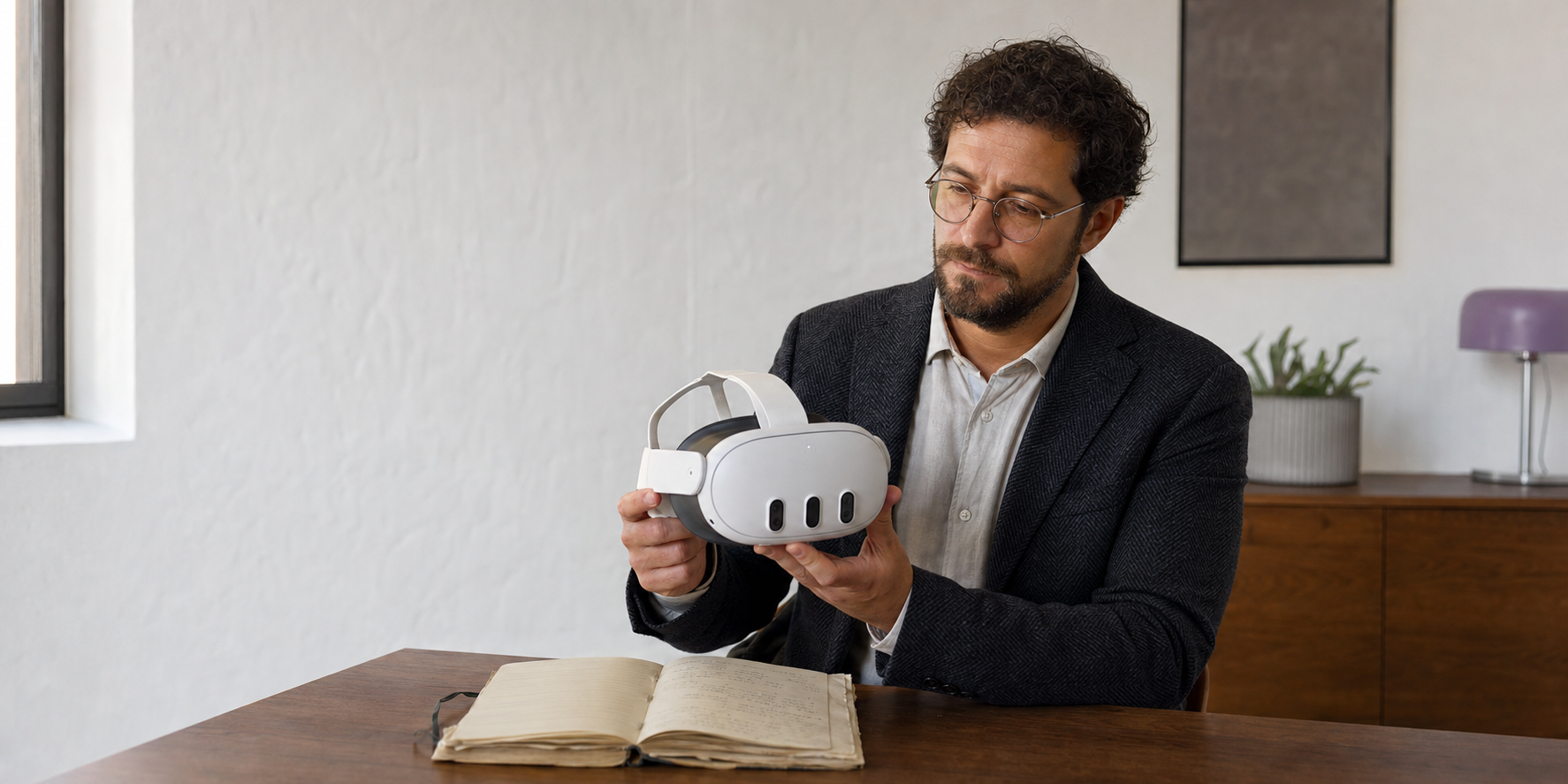
What VR for Psychologists Actually Is
When we talk about VR for psychologists, we don't mean a video game or a consumer gadget — we mean a clinical tool: three-dimensional environments that reproduce feared situations, which the clinician uses to run graded exposure from the therapy office.
The patient puts on a headset and enters a scene — a height, an animal, a flight, a room full of people — while the psychologist runs the session from a control panel, adjusting intensity and tracking anxiety. All of the therapeutic weight still rests on the clinician's judgment; the technology only supplies the stimulus.
Put differently, VR for psychologists is a way to apply a principle you already know even better: exposure as the treatment of choice for anxiety disorders. For a broader overview, read what VR exposure therapy is.
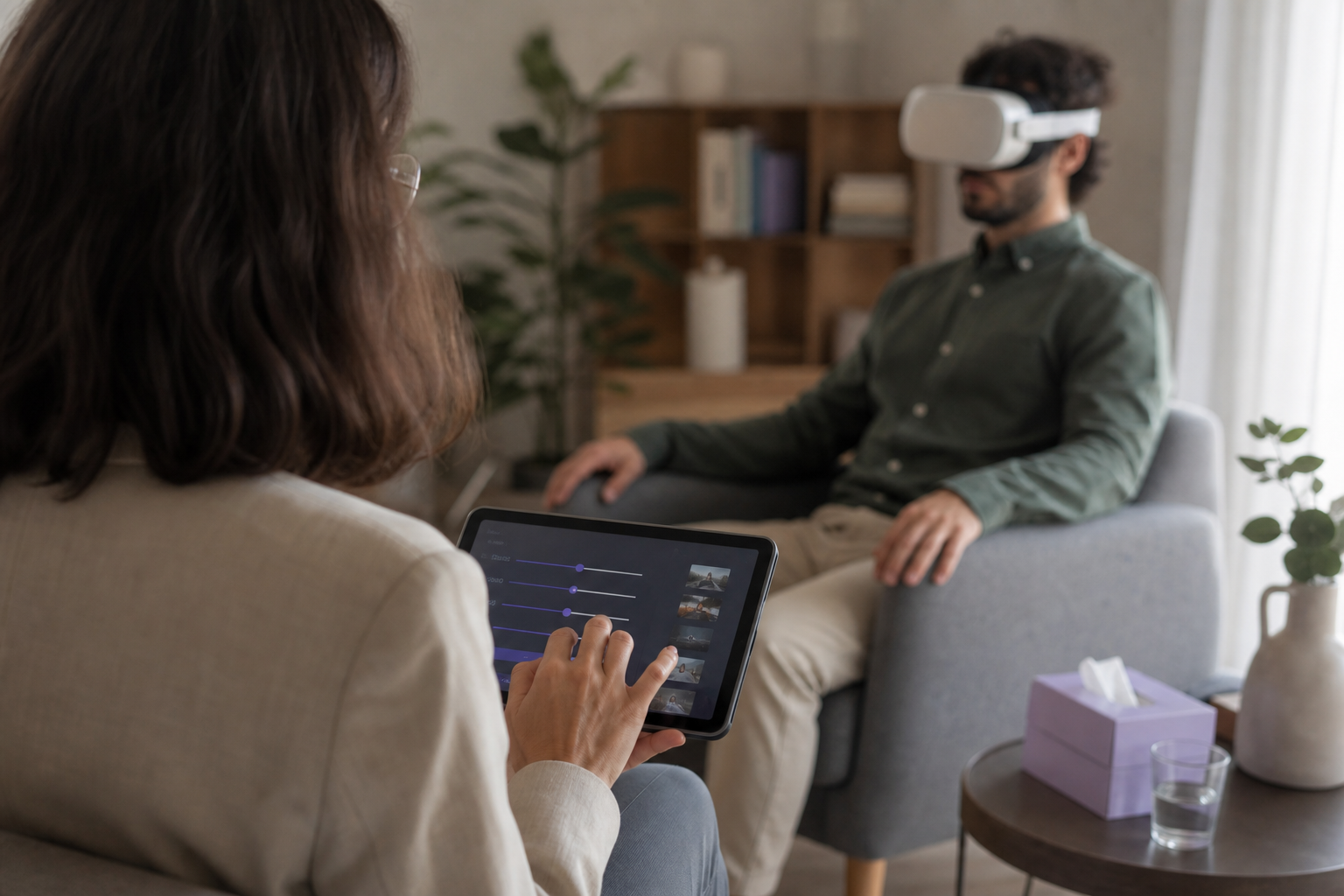
How It Differs from Imaginal and In Vivo Exposure
Imaginal exposure depends on the patient's ability to visualize, which varies widely. VR for psychologists removes much of that dependency: the stimulus is external, standardized, and reproducible, which also makes it possible to compare the patient's response from one session to the next.
Compared with in vivo exposure, the advantage is control. You can raise the height meter by meter, decide how many people are in a room, or stop the scene instantly, without the contingencies of a real environment. This makes it possible to work with situations that are expensive, dangerous, or hard to access, and it protects the patient's privacy, since they don't have to expose themselves in public.
The honest trade-off is that VR doesn't reproduce every sensory nuance of the real situation. That's why, when the case allows it, it's still advisable to plan a final step into in vivo exposure. VR is an excellent bridge toward that transfer.
There's a third factor, less often discussed but decisive in practice: acceptability. Some patients who refuse to face in vivo exposure do agree to start in a virtual environment, which they perceive as safer and more within their control. For those cases, VR for psychologists opens a therapeutic door that would otherwise stay closed.
Clinical Uses: What Psychologists Use It For
The natural territory of VR for psychologists is anxiety disorders. The most well-established applications are specific phobias — heights, animals, flying, enclosed spaces — social anxiety, and panic disorder with agoraphobia.
In these presentations, the psychologist builds a hierarchy of situations and uses VR to work through it in order, repeating each step until habituation is achieved. An applied example, transferable to other phobias, is our VR exposure protocol for dog phobia.
With more experience and appropriate caution, VR for psychology is also used in addressing post-traumatic stress disorder and in relaxation and emotional-regulation components, always within a broader treatment plan.
A strong point for clinicians is that the clinical logic doesn't change from one indication to another: the same skill in building exposure hierarchies that you use for a fear of heights also serves for a fear of flying or for social anxiety around public speaking. The virtual scenario changes; the therapeutic reasoning doesn't. That means the investment in learning the tool pays off across many different patient profiles.
What the Scientific Evidence Says
VR exposure therapy is one of the best-studied technological applications in clinical psychology. Powers and Emmelkamp's (2008) meta-analysis found it comparable to in vivo exposure for anxiety disorders, with a large effect size relative to control conditions.
The review by Carl et al. (2019), covering 30 randomized controlled trials and roughly 1,057 participants, concludes that VR is superior to control and non-inferior to in vivo exposure in specific phobias, social anxiety, PTSD, and panic disorder. Opriş et al. (2012) had already documented maintenance of results at twelve months, and Parsons and Rizzo (2008) reported a large effect size in specific phobias.
The takeaway for clinicians is clear: VR for psychologists isn't a marketing promise but an approach with empirical backing that matches the efficacy of classic exposure while adding control and acceptability. You can read more in our summary of the meta-analyses comparing VRET with in vivo exposure.
What Training and Skills You Need
The good news is that VR for psychologists doesn't require a technical background. If you already master exposure therapy, the equipment's learning curve is short: fitting the headset, running the panel, and selecting scenarios can be learned in a couple of practice sessions.
What it does require is clinical judgment. You need to know how to select cases, build realistic hierarchies, read anxiety curves, and decide when to move forward, when to stop, and when to make the jump to in vivo exposure. The tool doesn't replace any of that.
If you want to see how all of this plays out in day-to-day practice, we cover it in our guide on how to integrate VR into your practice.
How to Take the First Step
Bringing VR for psychologists into an already-running practice is simpler than it looks. The first step isn't buying equipment — it's identifying two or three patients on your current caseload who are a good fit: clear specific phobias, high motivation, and no contraindications.
The second step is getting familiar with the tool by running a couple of test exposures on yourself before using it with a patient. Knowing firsthand what they'll experience strengthens your ability to support them and to anticipate simulator sickness.
From there, integration is gradual: you start with those first cases, build up the technique, and gradually broaden the indications. There's no need to reorganize your schedule or your office to try it.
Limits and Clinical Precautions
VR for psychologists has limits worth keeping in mind. It isn't indicated for every presenting problem: its strength is exposure, not pure cognitive restructuring or interventions that require genuine social interaction.
There are relative contraindications — photosensitive epilepsy, advanced pregnancy, peripheral vertigo, and migraine with aura — that need to be assessed case by case. The most common side effect is simulator sickness, present in roughly 15-25% of people, generally mild and manageable by grading the exposure and letting the patient stop the scene at any time.
Used with sound judgment and within an evidence-based plan, VR for psychologists is a natural extension of the clinician's toolbox, not a shortcut. If you want to weigh the investment, you'll find the plans on the VRET pricing page.
This article is for informational purposes for psychology professionals. It is not clinical advice for any individual case and does not replace the judgment of the licensed psychologist in charge. VRET is professional clinical-support software, not a CE-marked medical device.
Frequently asked questions
What exactly is VR for psychologists?
It's a clinical tool that presents the patient with three-dimensional environments of feared situations to run graded exposure from the therapy office. The psychologist directs the session from a control panel; the technology supplies the stimulus, but the treatment remains the clinician's responsibility.
Does it work for every disorder?
No. Its most well-established territory is anxiety disorders: specific phobias, social anxiety, and panic disorder with agoraphobia. With experience, it's also applied to PTSD. It doesn't replace cognitive interventions or ones that require real social interaction.
Does it have scientific backing?
Yes. Meta-analyses and reviews of controlled trials (Powers and Emmelkamp, 2008; Opriş et al., 2012; Carl et al., 2019) show that VR exposure is effective and non-inferior to in vivo exposure for anxiety disorders, with results maintained at follow-up.
Do I need technical training to use it?
Not on the technical side: if you already master exposure therapy, learning to use the headset and the panel takes only a few sessions. What matters most is the clinical judgment to select cases, build hierarchies, and grade the exposure.
Can VR stand in for the psychologist?
Not at all. It's a support that complements the clinician's intervention. Assessment, case formulation, running the session, and interpreting results remain the exclusive responsibility of the licensed psychologist.
Keep reading
Can Online Exposure Therapy Work? The Clinical Limits
Whether online exposure therapy can be done at all, what professional support actually contributes, and which credentials authorise a clinician to deliver it.
Practice managementContraindications to Exposure Therapy: Risks and Cautions
Contraindications to exposure therapy, whether it can make anxiety worse and who it does not suit: exclusion criteria and clinical cautions.
Practice managementSUDS Scale: How to Measure Anxiety During Exposure
What the SUDS scale is, how anxiety is measured during exposure, and which indicators actually show whether a course of treatment is moving.
VRET is professional clinical-support software, not a CE-marked medical device. Clinical supervision remains with the licensed psychologist in charge.