Virtual Reality for Psychology Practices: A Clinical Guide
By Equipo VRET
Virtual reality for psychology practices lets clinicians expose patients to feared stimuli in a graduated, controlled way from within the practice itself, without the practical limits of in vivo exposure. This clinical guide summarizes what it is, which anxiety disorders it suits best, what the research evidence shows, what it costs to set up, and how to integrate it into a cognitive-behavioral therapy protocol without ever replacing your own professional clinical judgment.

What Virtual Reality for Psychology Practices Is
Virtual reality for psychology practices is the clinical use of computer-generated three-dimensional environments, presented through a headset, to expose the patient in a graduated way to the stimuli that maintain their problem. It is not entertainment or a technology demo: it is a tool at the service of the psychologist's clinical judgment, integrated within a cognitive-behavioral therapy protocol.
Unlike imaginal exposure, the patient doesn't have to mentally reconstruct the feared situation — they see it, hear it, and perceive it as present. And unlike in vivo exposure, you control every variable from the practice: the height, the number of people, the intensity of the stimulus, or the exact moment the scene stops.
How a Session Works
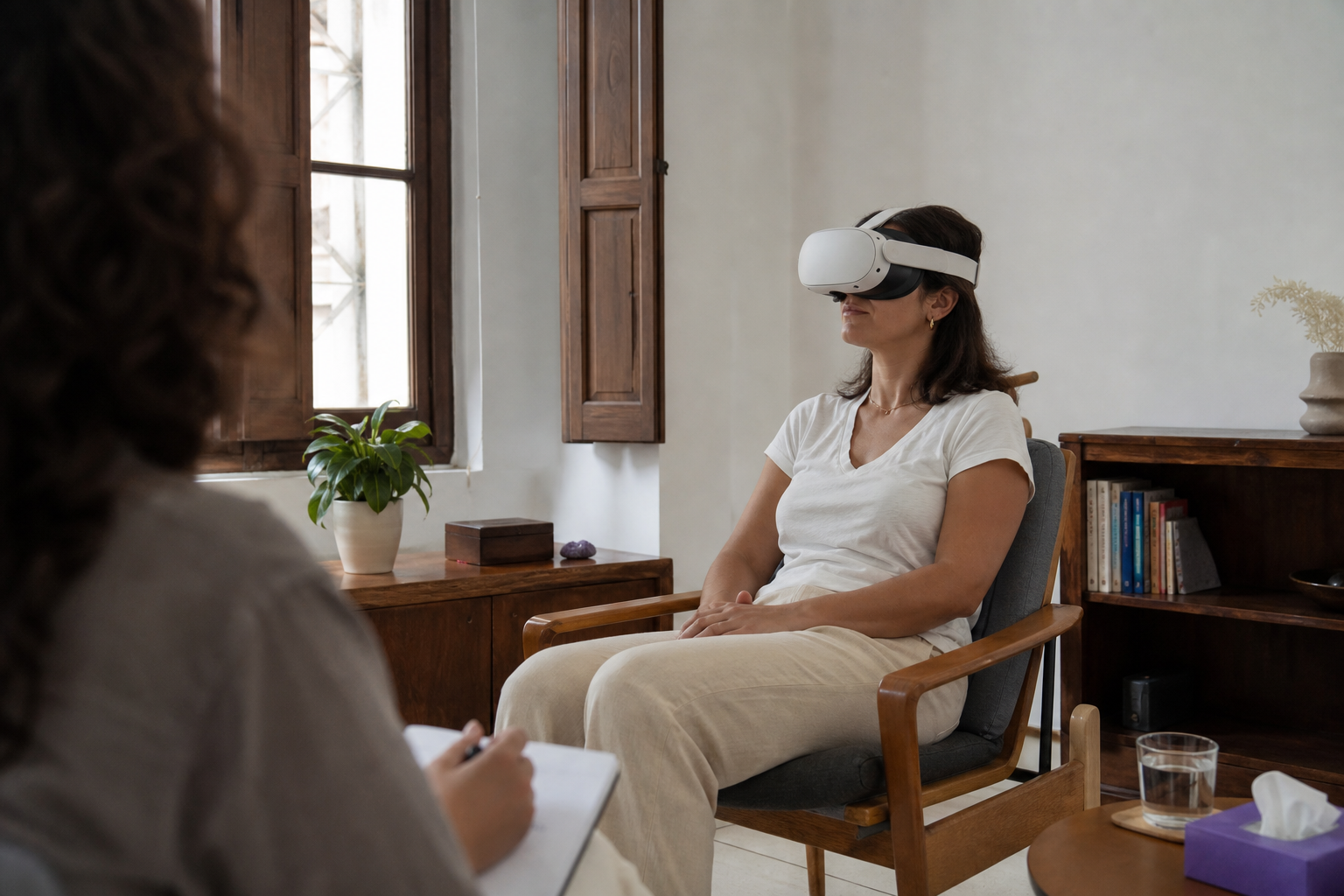
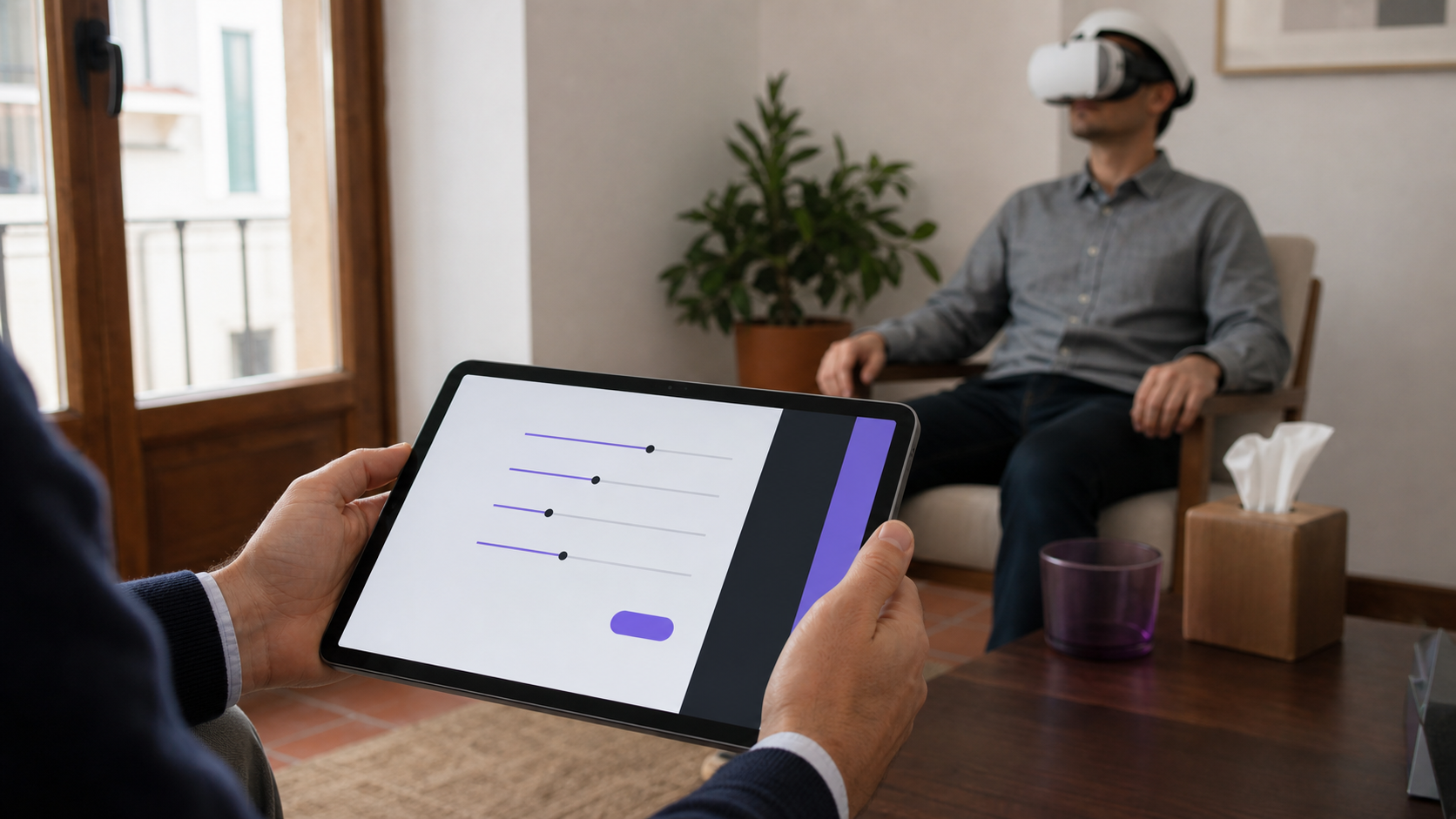
The patient puts on the headset and enters a scenario that reproduces the relevant clinical situation. From a control panel, the clinician adjusts the parameters in real time and records subjective units of distress (SUDS) throughout the exposure. The session stops instantly with a single gesture if arousal exceeds the patient's window of tolerance. You can find a fuller account of the method in our clinical guide to virtual reality exposure therapy.
Which Disorders It's Indicated For
The strongest evidence is concentrated in anxiety disorders. In practice, virtual reality is especially useful for specific phobias (heights, animals, flying, enclosed spaces), social anxiety disorder, panic disorder with agoraphobia, and, with appropriate caution, post-traumatic stress disorder. You can browse the full range of indicated scenarios in our scenario library.
The therapeutic principle doesn't change from classic exposure: you build a hierarchy of situations ranked by anxiety level and progress as habituation occurs. What VR adds is the ability to grade each step with precision and repeat the exposure as many times as the case requires — something almost impossible to organize with real-world stimuli.
It's worth being realistic about the limits. VR isn't indicated for every presenting problem: its natural territory is progressive exposure, not pure cognitive restructuring or interventions that require genuine social interaction. A detailed example of this logic is in our clinical VR exposure protocol for dog phobia, which can be applied as a template to other specific phobias.
What the Scientific Evidence Shows
Virtual reality exposure therapy has solid empirical support. The meta-analysis by Powers and Emmelkamp (2008) concluded that it is comparable to in vivo exposure for anxiety disorders, with a large effect size versus control conditions. Opriş et al. (2012) confirmed its efficacy and the maintenance of results at twelve months.
The most-cited review is Carl et al. (2019): 30 randomized controlled trials with about 1,057 participants show that VR is superior to control conditions and non-inferior to in vivo exposure for specific phobias, social anxiety disorder, PTSD, and panic disorder. For specific phobias, Parsons and Rizzo (2008) had already described a large effect size.
One point that's relevant in practice is acceptability: some patients who refuse in vivo exposure do accept starting in a virtual environment, which they perceive as safer and more controllable. The honest reading is that VR doesn't promise better outcomes than good in vivo exposure — it matches its efficacy while adding control, safety, and reproducibility within the practice.
With this evidence base, virtual reality for psychology practices has become established as a first-line option within the cognitive-behavioral approach to anxiety disorders, rather than a passing fad tied to consumer technology.
Advantages Over Traditional Exposure
Compared with imaginal exposure, virtual reality reduces the dependence on the patient's visualization ability, which varies widely from person to person. The stimulus is standardized and reproducible, which makes it easier to compare progress across sessions.
Compared with in vivo exposure, it avoids travel, protects confidentiality (there's no need to be exposed in a public place), and makes it possible to work with situations that are expensive or hard to access, such as a takeoff or a great height. It also improves safety: the scene can be interrupted instantly, without the contingencies of exposure out in the world.
The trade-off is that VR doesn't cover every sensory nuance of reality, and it's worth planning the final step to in vivo exposure when the case allows it. It's an excellent bridge, not always the destination: done well, virtual reality for psychology practices shortens the path to that final exposure.
How It's Used in the Practice
The flow of a virtual reality session in the practice looks much like a conventional exposure session. You agree on the goal with the patient, select the scenario that fits their hierarchy, run the exposure while tracking anxiety, and close with a debrief on what was worked on.
The operational difference lies in clinical control: you can raise or lower the intensity without leaving the practice, pause the scene and resume it, or repeat a step as many times as needed. Continuous SUDS tracking throughout the session gives you an objective habituation curve that documents progress and guides the next session.
Virtual reality for psychology practices really pays off when it's built into a stable working routine. If you want the step-by-step operational detail — physical space, first session, and routine — we cover it in the guide on how to integrate virtual reality into your practice.
Cost and Return on Investment for the Practice
Setting up virtual reality for a psychology practice requires two elements: a standalone headset and clinical software with scenarios and a control panel. The headset is a moderate one-time cost; the software is typically billed as a monthly subscription, which avoids a large upfront investment.
From a return-on-investment standpoint, VR lets you offer a differentiated service and bill the exposure session as a specific line item. It's worth running the numbers with real data from your practice — number of sessions, price per session, and monthly cost — before deciding. You'll find the plans on the VRET pricing page and the equipment breakdown in our comparison of VR headsets for clinical practice.
How to Get Started and Clinical Precautions
To start using virtual reality for psychology practices, you need prior competence in exposure therapy, familiarity with the headset and control panel, and careful case selection. VR is a tool within your clinical judgment, not a substitute for assessment or the therapeutic relationship.
Contraindications and Side Effects
Relative contraindications include photosensitive epilepsy, advanced pregnancy, peripheral vertigo, and migraine with aura; assess these on a case-by-case basis. The most common adverse effect is simulator sickness, which occurs in roughly 15-25% of people and tends to be mild and transient if the exposure is well graded and breaks are allowed.
As a reminder, VRET is professional software that supports clinical practice: the indication, conduct, and interpretation of every session always remain the psychologist's responsibility. To organize the rollout, you can use our checklist for bringing VR into your practice.
This article is for informational purposes for psychology professionals. It is not clinical advice for any individual case and does not replace the judgment of the licensed psychologist in charge. VRET is professional clinical-support software, not a CE-marked medical device.
Frequently asked questions
Does virtual reality replace traditional psychological therapy?
No. It's a tool integrated within an evidence-based treatment, usually cognitive-behavioral therapy. VR facilitates the exposure phase, but assessment, case formulation, and the therapeutic relationship remain the psychologist's exclusive responsibility.
Do I need specific training to use virtual reality in my practice?
You need prior competence in exposure therapy and familiarity with the headset and control panel. It doesn't require advanced technical knowledge, but it does require clinical judgment to select cases, build hierarchies, and grade the exposure.
What equipment do I need to get started?
A standalone virtual reality headset and clinical software with scenarios and control from within your practice. The details on models, space, and cost are covered in our guide on what you need to use virtual reality in your practice.
Is it safe for the patient?
It's safe in most well-selected cases. There are relative contraindications (photosensitive epilepsy, advanced pregnancy, vertigo, migraine with aura) and one frequent, mild side effect, simulator sickness, which is managed by grading the exposure and being able to stop the scene instantly.
Which disorders have the most evidence?
Anxiety disorders: specific phobias, social anxiety disorder, and panic disorder with agoraphobia, with efficacy comparable to in vivo exposure according to the available meta-analyses. For PTSD there is favorable evidence, but it calls for greater caution and clinical experience.
Keep reading
What Is Virtual Reality Exposure Therapy? A Patient Guide
What happens during a session, how many sessions it usually takes and how virtual reality exposure therapy differs from conventional treatment.
Practice managementCan Online Exposure Therapy Work? The Clinical Limits
Whether online exposure therapy can be done at all, what professional support actually contributes, and which credentials authorise a clinician to deliver it.
Practice managementContraindications to Exposure Therapy: Risks and Cautions
Contraindications to exposure therapy, whether it can make anxiety worse and who it does not suit: exclusion criteria and clinical cautions.
VRET is professional clinical-support software, not a CE-marked medical device. Clinical supervision remains with the licensed psychologist in charge.